
Every percentage point on your interest rate adds about $10,000 a year in interest for each $1 million you owe. That part is simple. The harder question is how a farm budget copes with higher interest rates: what another half point or full point does to your profit, and to the ratios your bank checks, in a year when the season goes wrong as well.
As at November 2026 the RBA cash rate is 4.85 per cent after five rises this year, the latest on 3 November, its highest since 2008, and economists are divided on whether there is more to come. The test below does not depend on the next decision. It works at whatever rate you are paying.
Search for the farm version of this question and you mostly get home loan calculators and overseas extension papers. This is the Australian version, worked in dollars on an illustrative farm, using the ratios your bank will recalculate and the sensitivity methods I set out in Farming the Business, the GRDC manual I wrote in 2015. By the end you will have a five-step test to run on your own numbers and a list of what to take to the bank.
Quick Answer
To stress-test a farm budget for higher interest rates, add 0.5 and then 1 percentage point to every variable loan and overdraft rate. Recalculate finance costs and interest cover, which is operating profit divided by finance costs. Each point adds about $10,000 a year per $1 million borrowed. Then rerun it with a poor season, the combination that breaks budgets.
- The example farm can cover the rate rise. On $1.2 million of term debt, half a point costs $6,000 a year and a full point $12,000. In the worked example below, a full point takes interest cover from 2.73 to 2.42 times, still in the range the manual rates as strong.
- With a poor season as well, interest cover falls to 1.08 times. Add a season that takes 10 per cent off income and the same rise takes interest cover to 1.08 times, a whisker above the point where operating profit no longer covers the interest.
- Two levers are yours: the depth of the overdraft trough, and your customer margin, the one part of the rate you can negotiate.
Where rates are, and what the Reserve Bank has signalled
The cash rate has risen five times in 2026. Rises on 3 February, 17 March and 5 May took it from 3.60 to 4.35 per cent, undoing all three cuts of 2025. After holding on 11 August the Board lifted it again on 29 September, to 4.60 per cent, and on 3 November, to 4.85 per cent. The November decision was split six votes to three, and the Board said it “will continue to do what it considers necessary to bring inflation sustainably back to target”.
The next decision is due on 8 December. In early October, ANZ and Westpac economists forecast the November rise, while Commonwealth Bank and NAB expected a hold. After it, CommBank’s economists said they expect the cash rate to stay on hold, with another rise in 2027 still a risk. Concessional money has moved too: the Regional Investment Corporation lifted its variable rate from 5.18 to 5.71 per cent on 1 August 2026, its first increase in two years, with the next change possible on 1 February 2027.
The timing is awkward. ABARES reported in March 2026 that lending to the farm sector reached $142.5 billion in 2024-25, and that loans and leases more than 90 days past due rose from $1.18 billion to $2.1 billion over the year. Its September outlook forecasts average broadacre farm business profit of $133,000 in 2026-27, down 39 per cent from $219,000. More debt, at a higher rate, against a lower profit forecast is exactly what a stress test is for.
How the rate on your farm loan is built
Banks publish base or reference rates, but not the rate your farm business actually pays, so any “typical farm loan rate” you read is an estimate. What sits between the Reserve Bank’s number and yours is set out in section 6.1 of the manual: a base rate plus a customer margin.
The bank starts from a base rate, which covers its cost of funds, operating costs and return to shareholders and is affected by the cash rate, the economy and the demand for money. An overdraft tends to carry a higher base rate than a fully drawn term loan. On top, the bank adds a customer margin: its price for the risk it sees in lending to you in particular.
When the Reserve Bank moves, the base rate tends to move with it. The customer margin is yours, and it is negotiable. More on that in the section on what to change first.
For the worked examples I use an illustrative 7.75 per cent on term debt and 8.5 per cent on the overdraft. They are not quotes or averages. They are consistent with a useful public reference point: RIC says its loans average about 2 per cent below comparable commercial lending rates, which against its 5.71 per cent implies commercial rates in the high sevens. Put your own rates in; the method does not change.
One line of my own has not aged well. In the manual I suggested a 5 per cent move in interest rates was probably less likely than one in prices and yields, “given the relatively stable interest rates in recent years”. Fair in 2015, not safe now: the point and a quarter added in 2026, on a lending rate in the high sevens, is a shift of roughly 16 per cent, more than three times the manual’s test.
What happens to farm debt if rates rise 0.5% or 1%
On interest alone, every percentage point is $10,000 a year for each $1 million borrowed, so each quarter-point move by the Reserve Bank is $2,500 a year per $1 million, if your lender passes it on in full. Take an illustrative business with a $1.2 million term loan and a seasonal overdraft that averages $200,000 drawn across the year, peaking much higher before harvest.
| Annual interest | Today (illustrative) | Rates +0.5 point | Rates +1 point |
|---|---|---|---|
| Term loan, $1.2 million (7.75% today) | $93,000 | $99,000 | $105,000 |
| Overdraft, averaging $200,000 drawn (8.5% today) | $17,000 | $18,000 | $19,000 |
| Total interest | $110,000 | $117,000 | $124,000 |
| Extra cost a year | $7,000 | $14,000 |
Illustrative rates, not quotes. Term loan interest is on the full $1.2 million for the year. Overdraft interest is on the average balance drawn, not the limit.
That extra $14,000 a year at a full point comes out of the same cash as drawings, principal repayments and the next machinery payment.
On a 15-year principal and interest loan reset to keep its term, the monthly repayment rises from about $11,295 to $11,642 at half a point and $11,993 at a full point: about $4,200 and $8,400 a year. That is less than the rise in interest because, early on, principal is repaid more slowly. The debt comes down more slowly. It does not get cheaper.
The overdraft is a different animal
Overdraft interest is charged on the balance drawn, for the days it is drawn: the trough, not the limit. So the depth and length of the trough usually matter more than the rate.
If a poor harvest, or grain payments that arrive late, keep the overdraft averaging $350,000 instead of $200,000, the interest at 8.5 per cent rises from $17,000 to $29,750. That extra $12,750 is more than six times what a full point adds to the same overdraft.
A year can be profitable and still leave the overdraft deep, the gap our piece on farm profit versus cash flow explains, and our guide to building a farm cash flow forecast shows how to find your own trough.
Interest cover ratio and debt servicing: what the bank will recalculate
A rate rise shows up at the bank as a weaker ratio. As the manual notes (section 5.5.1), banks calculate most of their ratios from your tax return, and two go straight to whether you can carry the debt.
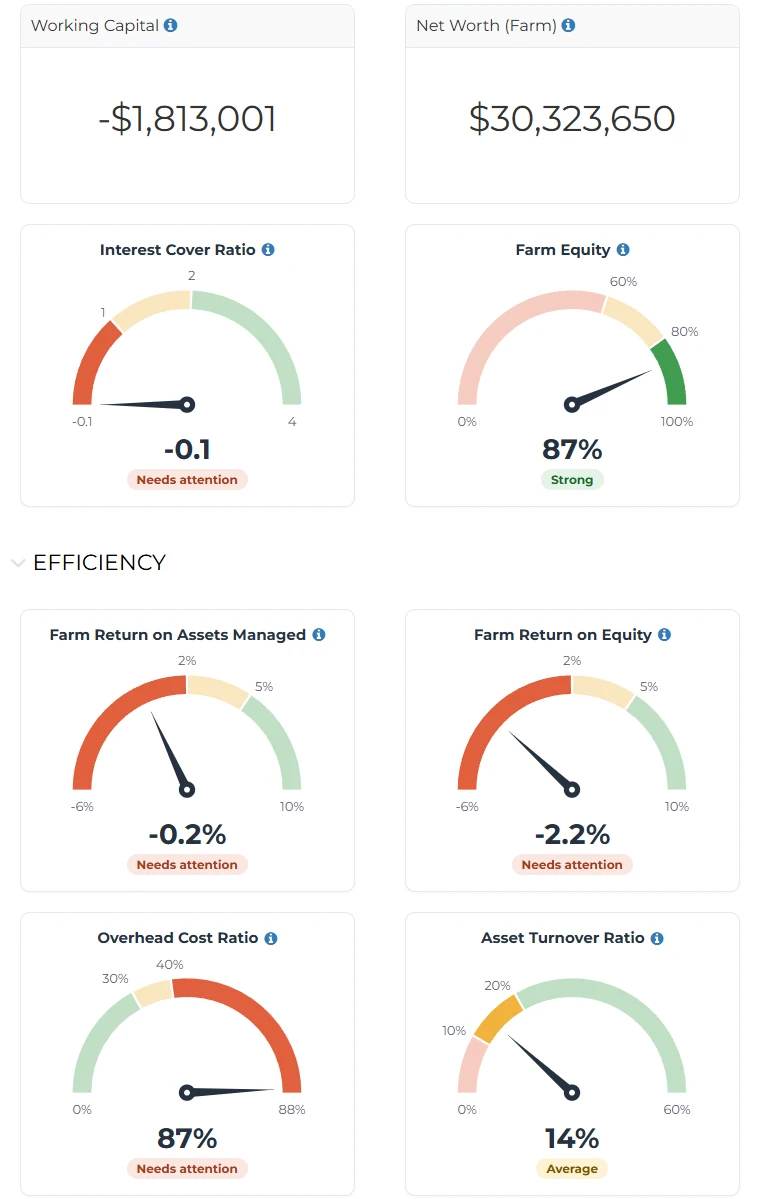
Interest cover is operating profit (earnings before interest and tax) divided by finance costs: how many times over the business could pay its interest from farming. At 1, operating profit only just covers it. Term debt and lease cover asks whether the business can meet all its repayments, principal included.
| Ratio | How it is calculated | Weak | Strong |
|---|---|---|---|
| Interest cover | Operating profit (EBIT) ÷ finance costs | Below 1 time | Above 2 times |
| Term debt and lease cover | (Net profit after tax + finance costs + depreciation) ÷ (principal and interest payments + leasing costs) | Below 1 time | Above 1.5 times |
| Finance cost ratio | Finance costs ÷ gross revenue | Above 15% | Below 5% |
| Equity to assets | Owner’s equity ÷ total assets | Below 70% | Above 90% |
From Farming the Business (GRDC, 2015), Tables 5.21 and 5.25, developed with Tony Hudson of Hudson Facilitation. Guide ranges, not any lender’s covenants. The manual’s sample farm, ‘Upndowns Farm’, sat at 2.3 times interest cover and 1.8 times term debt cover, with a finance cost ratio of 16.8 per cent that the manual flagged as a weakness.
Two cautions before you calculate your own. The manual’s operating profit is struck after a family drawings or managerial allowance, $120,000 in its example, so it is stricter than an EBIT taken straight off a tax return; leave the allowance out and the ratio flatters you. And the ratios in your loan documents are the ones that count, so ask your lender how it defines each one and what your facility requires.
What should worry you? Below 2 times interest cover you are out of the manual’s strong range, and as it approaches 1 there is almost no room left for a poor season. Our guide to healthy farm borrowing in 2026 treats 3 times as comfortable, a sensible buffer when rates and seasons are both moving.
If you do not know your own interest cover, get that number before anything else, because it is the ratio a rate rise hits most directly. You do not need a paid plan to see where you stand: the free Essentials plan in P2PAgri calculates the key bank ratios, interest cover among them, from your Xero or MYOB data.
How to stress-test your farm budget for higher interest rates: five steps
This is the sensitivity analysis I set out in the manual (sections 7.1 and 11.2): change one thing at a time, hold everything else still, and see what moves. Then change the things that tend to go wrong together, together.
Step 1: List every facility, its balance and its rate
Term loans, the overdraft, machinery finance, any RIC loan and leases, each with its balance, rate, repayment, and whether it is fixed or variable. For the overdraft use the average balance drawn, not the limit, and note the peak and its month. A RIC loan is variable but is reset on 1 February and 1 August rather than moving with your bank.
Step 2: Add 0.5 and 1 percentage point to every variable rate
Half a point is two quarter-point moves and a full point is four, a margin over the further rise some forecasters still see in 2027. A fixed loan does not move until its fixed period ends, so test any fixed period expiring inside the budget year at the rate it rolls onto.
Step 3: Recalculate finance costs, profit and interest cover
Here is the illustrative business in an average season. It turns over $1.5 million, with variable costs of $600,000, overheads of $360,000, depreciation of $120,000 and a $120,000 managerial allowance, leaving operating profit of $300,000. It carries the $1.2 million term loan and the $200,000 average overdraft, and repays $80,000 of principal a year.
| Average season | Budget at today’s rates | Rates +0.5 point | Rates +1 point |
|---|---|---|---|
| Gross farm income | $1,500,000 | $1,500,000 | $1,500,000 |
| Operating profit (EBIT) | $300,000 | $300,000 | $300,000 |
| Finance costs | $110,000 | $117,000 | $124,000 |
| Net profit before tax | $190,000 | $183,000 | $176,000 |
| Interest cover | 2.73 times | 2.56 times | 2.42 times |
| Term debt cover (before tax) | 2.21 times | 2.13 times | 2.06 times |
| Finance cost ratio | 7.3% | 7.8% | 8.3% |
Illustrative business, excluding GST. Term debt cover is shown before tax to keep the arithmetic visible: net profit before tax plus finance costs and depreciation, divided by interest plus $80,000 of principal. The manual’s after-tax version gives a lower result.
Nothing breaks on rates alone. A full point costs this business $14,000 a year and takes interest cover from 2.73 to 2.42 times, still in the manual’s strong range, while term debt cover slips from 2.21 to 2.06. Worth knowing: the rate on its own is not the thing to lose sleep over. It is also not the whole test.
Step 4: Run it again with a poor season
Hold costs at budget, because most of a cropping year’s inputs are committed before the season declares itself, which is how the manual’s own seasonal tables treat them. Then take income down and let the overdraft run deeper for longer. Here a poor season takes 10 per cent off income and lifts the average overdraft from $200,000 to $350,000.
| Average season, today’s rates | Poor season, today’s rates | Poor season, rates +1 point | |
|---|---|---|---|
| Gross farm income | $1,500,000 | $1,350,000 | $1,350,000 |
| Operating profit (EBIT) | $300,000 | $150,000 | $150,000 |
| Average overdraft drawn | $200,000 | $350,000 | $350,000 |
| Finance costs | $110,000 | $122,750 | $138,250 |
| Net profit before tax | $190,000 | $27,250 | $11,750 |
| Interest cover | 2.73 times | 1.22 times | 1.08 times |
| Term debt cover (before tax) | 2.21 times | 1.33 times | 1.24 times |
Same illustrative business and rates, costs held at budget.
This is where it breaks. Interest cover falls to 1.22 times on the season alone and 1.08 times with the rise on top, a whisker above the point where operating profit no longer covers the interest. Net profit before tax goes from $190,000 to $11,750, and term debt cover drops below the manual’s 1.5 strong line, to 1.24.
Of that $178,250 fall in profit, the season and the deeper overdraft account for $162,750. The 1 point rate rise is $15,500, less than a tenth. But it is the tenth that lands when there is nothing left to absorb it.
And 10 per cent is a mild poor season. Take 20 per cent off this farm’s income and operating profit falls to nothing, at which point no interest rate is low enough.
The manual’s own seasonal-and-price test (Table 11.6) cut its sample farm’s income by about a fifth, and by my arithmetic its interest cover went from 2.8 to 1.3 times. It survived on an operating margin of about 40 per cent. This example earns 20. How hard a poor season hits depends on your margin before it depends on your rate.
The manual’s ‘5% shift’ makes the same point. Moving each factor on the sample farm by 5 per cent, one at a time, a change in the interest rate from 8.5 to 8.075 per cent on its $2.6 million of bank loans moved profit by $11,050, eighth of 31 factors, behind the exchange rate and six lamb, canola and wool price and production measures.
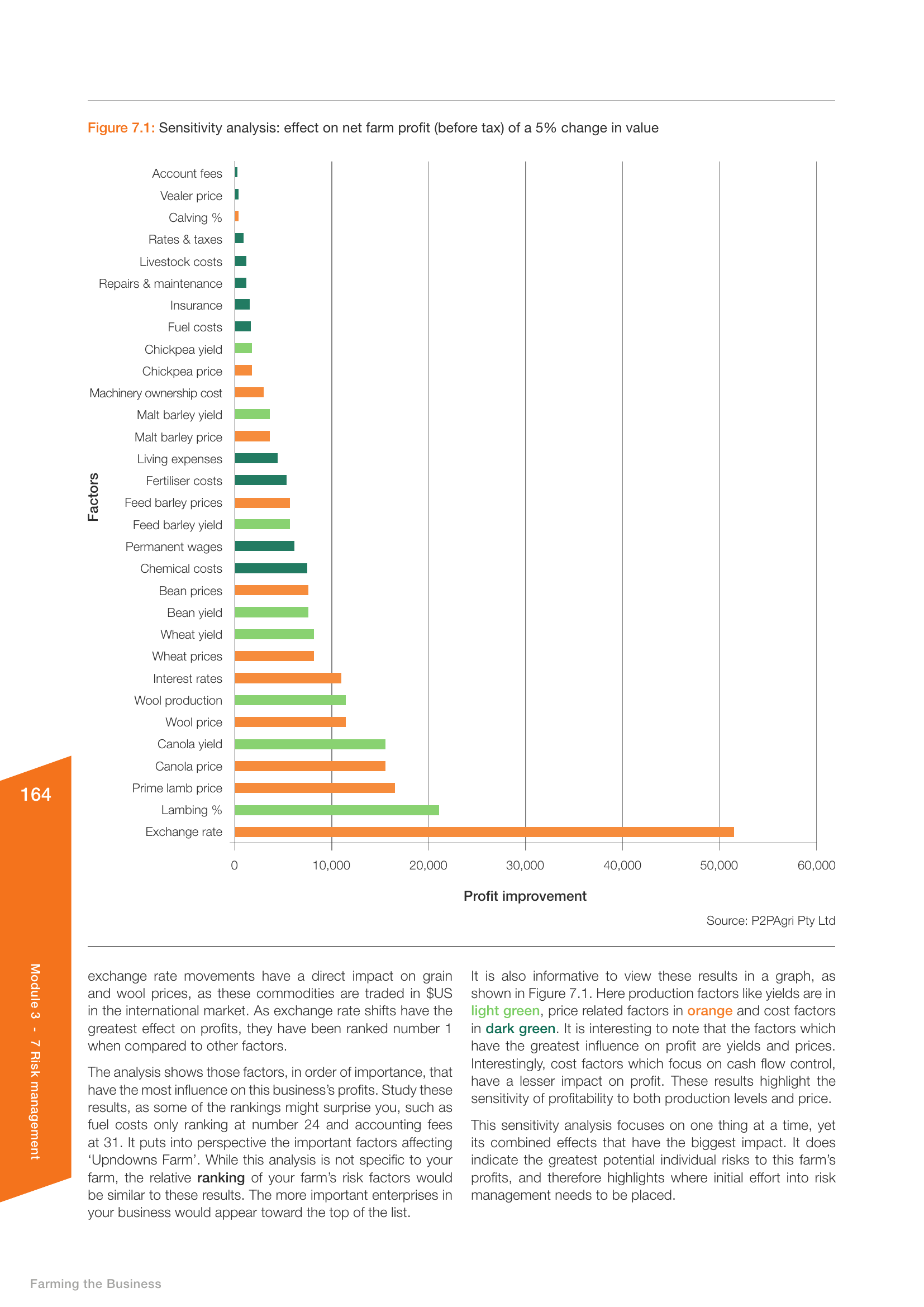
The manual warned that yields and prices can move far more than 5 per cent in a year while most costs track inflation. Interest rates now sit in between, which is why they belong in the test alongside the season, not instead of it.
Step 5: Write down what you would change if it fails
A stress test that fails is not a verdict. It is a to-do list. Write down what you would do first and rerun the numbers with it before you take them to anyone; the levers are in the next section.
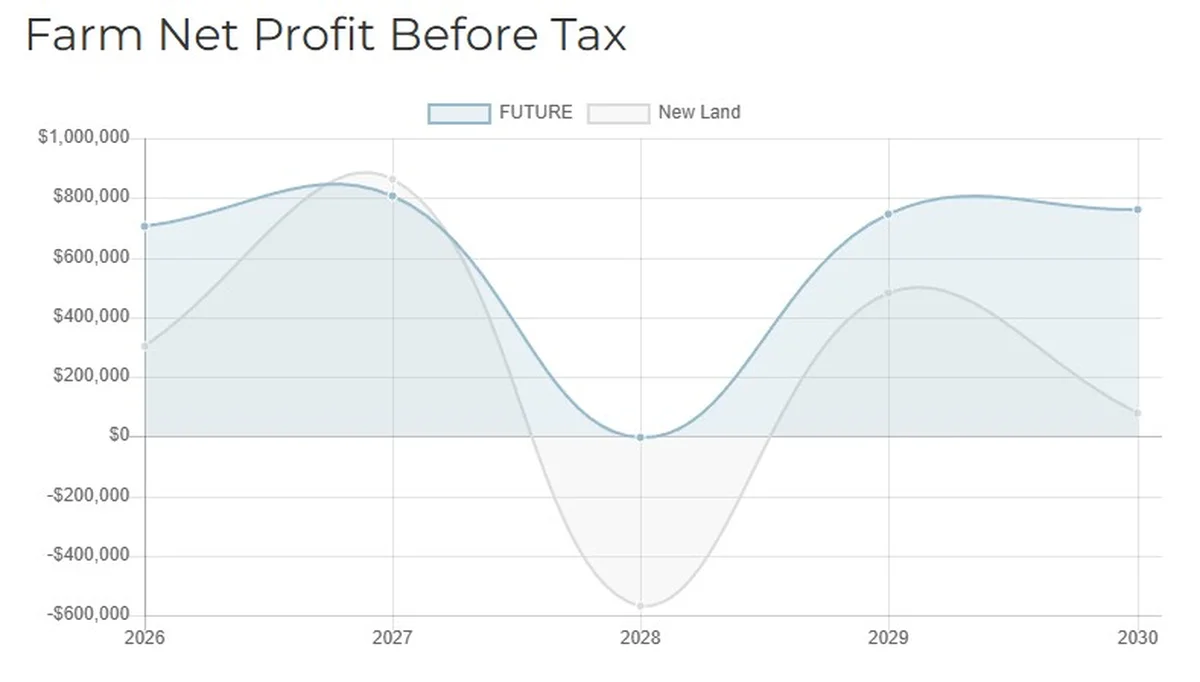
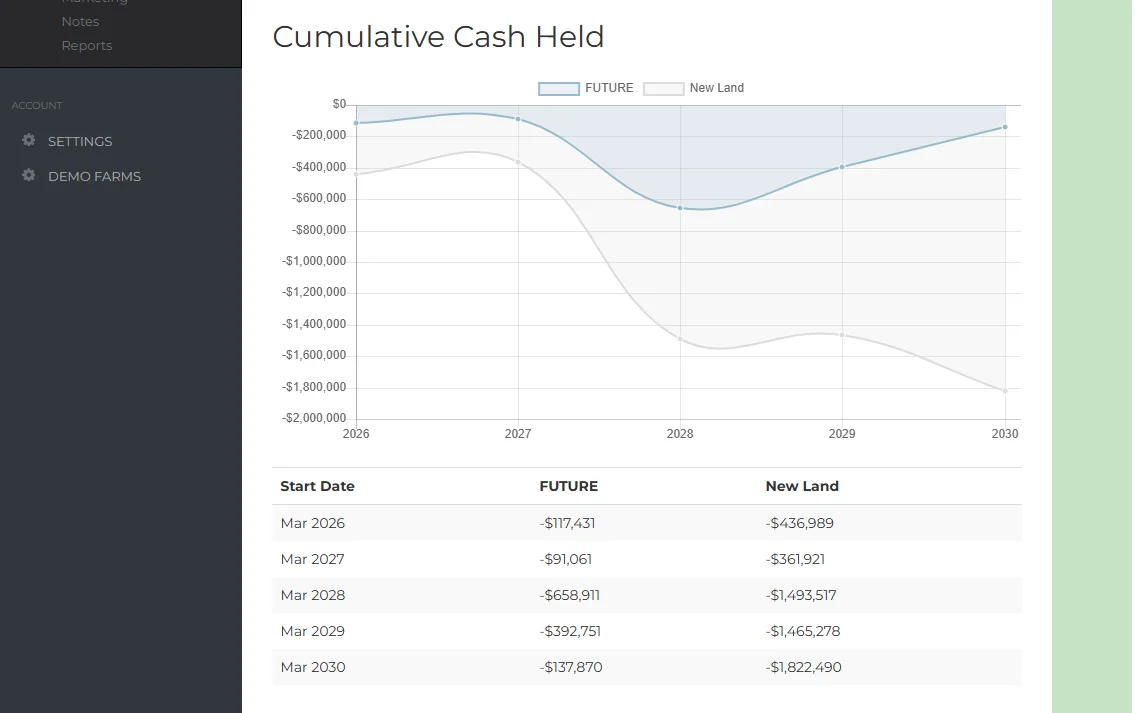
You can do all of this once in a spreadsheet, and it is worth doing. Running it across five years, with the seasons varying, is where software earns its place. In P2PAgri’s scenario analysis, on the Future plan, each scenario is a complete copy of your business plan with its own loans and overdraft, each carrying its own interest rate. Change the rates in one copy, add a poor season to another, and compare them side by side with your base plan over five years on profit, cash, EBIT, equity and returns, rather than on one line of interest. Interest cover is not one of the comparison measures, but Farm EBIT is, so you can work the ratio out by dividing it by that scenario’s finance costs.
Fixed or variable farm loan: framing the choice honestly
The first question after a stress test is usually whether to fix. Nobody can answer that without your numbers, but it can be framed.
- Fixing buys certainty on one line. It protects the interest bill for the fixed term. It does nothing about the season, which in the example above did nine tenths of the damage.
- The market has usually got there first. Fixed rates are priced off wholesale rates that already anticipate where the cash rate is expected to go, so once rises are widely forecast, much of them tends to be in the fixed rates on offer.
- Getting out can cost money. Repaying or restructuring a fixed loan early, after selling a block or refinancing after a poor year, can trigger break costs.
- It does not have to be all or nothing. In the manual (section 1.1.2) I suggested a mix of fixed and floating rates to keep some stability in the annual interest burden.
The stress test gives you a practical way in. Run the budget at the fixed rate offered and at the variable rate plus 1 point. If the business passes the plus 1 test comfortably, you may be paying for insurance you do not need. If it only passes at the fixed rate, certainty is worth more to you.
Then take these questions to your bank and adviser:
- What are the one, two and three year fixed rates against the variable rate today?
- How are break costs calculated?
- Can part be fixed and part left floating?
- What happens at the end of the fixed term?
- Does fixing change the security, fees or covenants?
What to change first when the stress test fails
Start with the overdraft. In the worked example, a deeper trough cost more than six times as much as a full point on the overdraft rate.
Shrink the overdraft peak
The trough is where the interest is, so make it shallower and shorter. Buy inputs when you need them rather than when they are offered, use supplier terms where they are genuinely cheaper than the overdraft, and look hard at when grain is sold and paid for. A grain marketing plan is a cash flow tool as much as a price tool, and our comparison of trade credit and the overdraft shows when supplier terms are the cheaper money.
Re-price the early payment discount
An early payment discount only pays if it beats the interest on the money used to take it. Paying a $300,000 fertiliser bill three months early out of the overdraft costs about $6,358 in interest at 8.5 per cent and $7,105 at 9.5 per cent, a point higher. At the higher rate the discount needs to beat about 2.4 per cent of the invoice, not 2.1.
Know what interest-only does and does not fix
Moving term debt to interest-only for a period, if your lender agrees, takes principal out of the year’s cash requirement and lifts term debt cover. It does nothing for interest cover, because the interest bill is unchanged, and it costs more over time: every $80,000 of principal left unpaid costs about $7,000 a year at 8.75 per cent for as long as it stays unpaid. It is a bridge through a poor year, not a fix for a budget that does not work.
Negotiate your customer margin, the part of the rate that is yours
You cannot argue with the cash rate. You can argue with your customer margin. In the manual (section 6.1.2) I set out how banks arrive at it: four of the “five Cs”, cash flow, character, capital and conditions, are rolled into a customer rating, and the fifth, collateral, is scored separately as a loan to value ratio and a security category.
The manual’s case study shows what that is worth. A farmer with $700,000 of debt against a $2 million farm has a loan to value ratio of 35 per cent. Offering another $400,000 of real estate as security moves them into the top security category, and in the example the margin falls from 1.8 to 0.3 per cent: $10,500 a year on the same loan. The margin figures are illustrative by design. The mechanism is not.
For scale, a quarter of a point off the margin on the $1.4 million our example farm borrows on average is worth $3,500 a year, the same as one quarter-point move by the Reserve Bank. The manual’s advice still stands: no surprise lending requests, offer extra collateral if you have it, ask what your customer rating is and how to improve it, and negotiate fees as well as rate. Our page on getting the best deal from your bank goes further.
Put Farm Management Deposits against the debt, where the rules allow
Farmers held $7.04 billion in Farm Management Deposits across 43,613 accounts at 30 June 2026, on Department of Agriculture, Fisheries and Forestry figures. Since 1 July 2016 the tax law has allowed an FMD to offset a loan of the owner’s own primary production business. In practice that means sole traders and partnerships, not farms run through a company or trust, and not every lender offers it. Worth asking your bank and accountant.
When to talk to the bank, and what to bring
Before you need something. The manual’s guideline (section 6.3) is twice a year when things are going well; about two months before harvest if a poor season is shaping up, because banks get busier after harvest; and monthly if the business is in difficulty. In 2026 that is live for many at once, with northern New South Wales and southern Queensland in drought under a strong El Niño, and our El Niño planning guide covers the seasonal side.
Take with you:
- A monthly cash flow forecast showing your peak debt and its month.
- A profit and loss budget and a current balance sheet.
- Your ratios, calculated the way your lender calculates them, with the trend over several years.
- The stress test: today’s rates, plus 0.5 and plus 1 point, and the poor season with the rise on top.
- What you would change if it fails, and what that does to the numbers.
- Your marketing plan: what is sold, what is not, and when the money arrives.
And know them yourself. As the manual puts it: “It is your business; you have to deliver on the numbers.” A banker who sees you have already run the bad case, with a plan for it, is looking at a lower risk than one who has to find it for you. See also what banks look for when lending to farmers, and once harvest is in, our post-harvest farm business review is the natural point to rerun all of this with actuals.
About the detail here
Rates checked as at 6 November 2026, after the Reserve Bank’s 3 November decision. The RIC rate of 5.71 per cent applies from 1 August 2026. The 7.75 and 8.5 per cent rates and the example business are illustrative, not quoted figures, and exclude GST. Ratio ranges are the guides in Farming the Business (GRDC, 2015), not any lender’s covenants, and its dollar figures are 2015 illustrations. General information, not financial advice: take decisions about fixing, restructuring or refinancing to your bank and adviser.
The short version
A rate rise is the easiest risk in a farm budget to measure: about $10,000 a year per point for every $1 million borrowed. On a reasonably geared budget like the one above, the rate on its own bends the numbers without breaking them.
Then run it with a poor season, because the bank will run that test in its head whether you do or not. If the two together take interest cover toward 1, act while there is time: shrink the overdraft trough, re-price the early payment discounts, negotiate the margin that is yours, and walk into the bank with the plan rather than the problem.
If you do only one thing this week, find out your interest cover as it stands today, then work it out again with rates a point higher.
Keep reading
What Supplier Trade Credit Actually Costs You (Compared With an Overdraft)
What does supplier trade credit really cost compared with an overdraft? Work out the true rate on settlement discounts and price premiums for farm inputs.
Farm Lending After the Royal Commission with Matt O'Dea
Podcast: ex-agribusiness banker and broker Matt O'Dea on farm lending after the Royal Commission, hidden fees, brokers and choosing a bank that sticks.

What Banks Really Look For When Lending to Farmers
Podcast: what banks really look for when lending to farmers. Mike Krause explains the three things every lender weighs up and how you can influence your rate.