
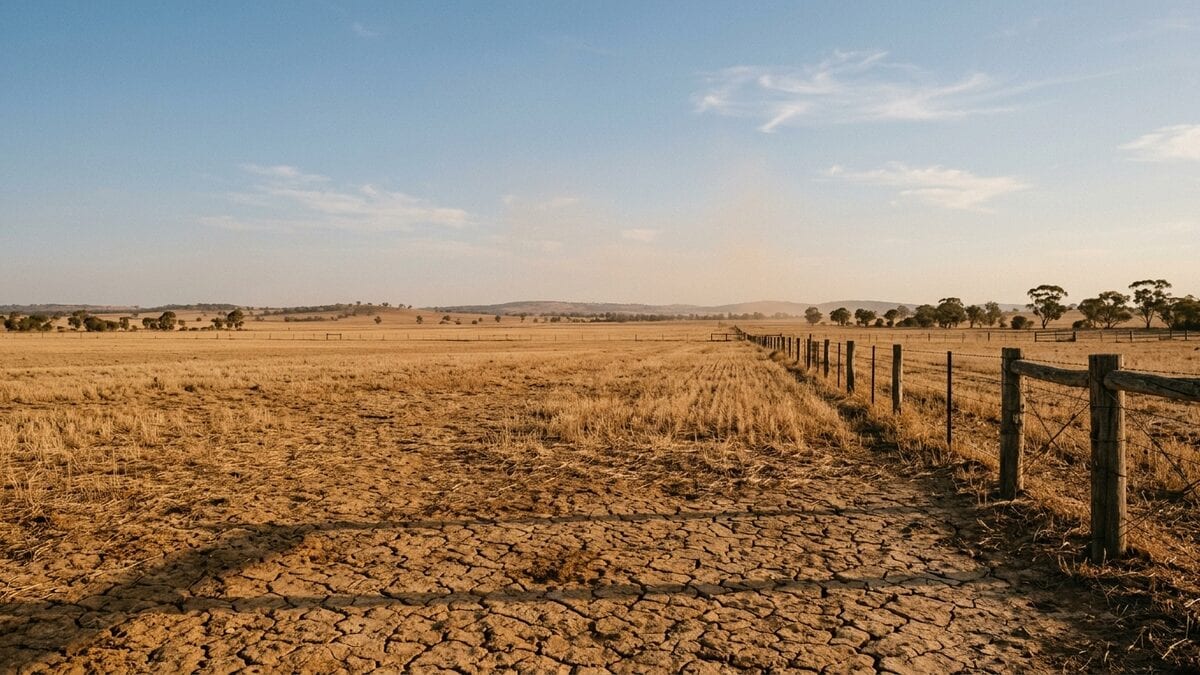
The Bureau of Meteorology is openly warning that El Niño could form in Australia between late autumn and the end of winter 2026, and several international models put the odds of a strong event above 80 percent. Some commentators are using the phrase “super El Niño”.
For Australian farmers, the planning question is not what to call it. The question is what a drier than average winter and spring would do to your cash flow, your equity, and your loan covenants, and at what point you would need to change a decision in response.
This guide walks through what the forecast actually says, what history tells us about El Niño years on Australian farms, and the four financial scenarios every operator should run before the season locks in.
Quick Answer
The Bureau of Meteorology rates El Niño formation by winter 2026 as a Watch-level probability, with international models putting the odds of a moderate to strong event at 61 to 80 percent. Australian El Niño years average 28 percent below-average rainfall in the Murray Darling Basin and historically coincide with the country's worst droughts. Farms that go in with four scenarios already modelled, peak overdraft known, and trigger points written down keep their decision room. Farms that wait until the rain has failed do not.
What the Bureau of Meteorology Is Actually Saying About El Niño in 2026
As of May 2026, the official Pacific Ocean state is ENSO neutral. The Bureau of Meteorology and overseas agencies expect that to change. NOAA's Climate Prediction Center puts the chance of El Niño emerging during the May to July 2026 window at 61 percent, and the European Centre for Medium Range Weather Forecasts has the probability of a moderate to strong event developing by August at roughly 80 percent. BoM itself notes that forecasts at this time of year carry the “autumn predictability barrier”, so all of these numbers should be read as probabilities rather than certainties.
In plain English, El Niño is a warming of the central and eastern tropical Pacific Ocean that weakens the easterly trade winds. The flow on effect for Australia is a reduction in the warm, moist air that normally pushes across the continent from the east. The result is typically below average rainfall through winter and spring, warmer day temperatures, lower soil moisture at sowing, and an elevated risk of heat events and frost extremes during grain fill.
The Bureau's long range outlook is the most reliable Australian source for this. The ENSO Outlook dashboard is updated fortnightly and uses a five stage status (Inactive, Watch, Alert, El Niño, La Niña). If you check one thing each fortnight between now and August, make it this page.
Why “Super El Niño” Is a Media Phrase, Not a Forecast Category
The phrase has been showing up in headlines from SBS, the ABC and most weekend agricultural news bulletins. It is worth pausing on what it actually means.
“Super El Niño” (sometimes written “super El Nino”) is a colloquial term for an event where central Pacific sea surface temperatures rise around two degrees or more above the long term average. The Bureau of Meteorology is unusually direct about this in its own published material: “You may sometimes see El Niño events described as ‘super’ or ‘rare’ but these descriptions are not used in our El Niño-Southern Oscillation classifications.” As several Australian climate scientists have pointed out, the strength of the Pacific signal also does not map neatly onto the strength of the rainfall impact in Australia.
A useful reminder: 2015 was one of the strongest El Niño events on record. Rainfall across much of Australia that year ended up close to average. By contrast, the 2018 to 2019 event was weaker on paper but coincided with the worst farm cash income decline in a generation.
The planning takeaway is simple. Do not anchor your decisions on a headline label. Anchor them on what a 20 to 40 percent rainfall reduction would do to your specific budget, because that is the band that matters for most Australian production systems.
What History Tells Us About El Niño and Australian Farm Profits
Across all El Niño events since 1900, average winter and spring rainfall in the Murray Darling Basin has been roughly 28 percent below the long term mean. The Basin contains around 40 percent of Australian farms by number, so this single statistic does a lot of explanatory work.
The five most severe Australian droughts on record (1982, 1994, 2002, 2006 and the Millennium Drought peak years) all coincided with El Niño conditions. The economic footprint at a national level is large. ABARES data shows the 2018 to 2019 drought reduced Australian farm cash income by 41 percent nationally, with grain production falling more than 50 percent in the worst affected regions.
Three patterns recur in El Niño years on broadacre farms:
1. Yields drop faster than costs. Most variable inputs (fertiliser, fuel, seed, chemical) are committed early in the season regardless of how it finishes. When yields come in 30 to 50 percent below budget, the gross margin per hectare collapses while the cost base barely moves.
2. Livestock costs rise sharply. Fodder prices climb well ahead of any rainfall decline as graziers in marginal country destock and competition for hay intensifies. The cost of holding a breeding flock or herd through a dry winter and spring can wipe out 12 to 18 months of margin if you start buying feed late.
3. Working capital pressure shows up before profit does. Income arrives later (or not at all) while autumn input invoices, June tax liabilities, and quarterly interest payments do not move. Most farm businesses run into an overdraft ceiling 6 to 9 months before the year end loss shows up in the accounts.
The implication is that the financial planning has to happen now, not when you have actual rainfall data. By the time the rain has failed, the most valuable decisions are already behind you.
The Four Financial Scenarios Every Farm Should Model This Winter
The most useful thing you can do this month is not read another El Niño explainer. It is to sit down with your budget and model how four specific scenarios play out in your business. This is the core framework taught in the risk management module of the GRDC's Farming the Business manual, which Mike Krause authored on behalf of P2PAgri.
Scenario 1: Base case (current plan)
Your existing budget with average rainfall and your planned program. This is your reference point. Document it so the other three scenarios can be compared cleanly against it.
Scenario 2: Moderate El Niño (20 percent yield reduction)
Run your budget with crop yields and pasture growth reduced by 20 percent. Hold input costs at planned levels (you are committed to most of them). Model the impact on gross margin, monthly cash flow, peak overdraft, and your equity position at 30 June.
Scenario 3: Severe El Niño (40 percent yield reduction with destocking)
A 40 percent yield reduction is consistent with the 2018 to 2019 experience in the eastern states. For livestock operations, include a partial destocking event (typically 20 to 30 percent of breeders) with the income brought forward and the capital loss recognised. Model the same cash flow and equity impacts.
Scenario 4: Sustained drought (back to back dry years)
The variable that breaks most farm budgets is not a single bad year. It is two in a row. Repeat Scenario 3 for two consecutive seasons and look at the year two opening balance sheet. This is the scenario your bank will run if conditions deteriorate, so it pays to run it first.
For each scenario, write down three numbers: peak overdraft requirement, year end equity percentage, and interest cover ratio. These are the three figures your lender will focus on at your next review, and they are the figures that drive whether you have flexibility or whether decisions are made for you.
Worked Example: A 3,000ha Mixed Cropping Operation Through an El Niño Year
Consider a 3,000 hectare mixed grain and sheep operation in the NSW or SA wheat belt. Long term average yield is 3.0 t/ha across the cropping program. Variable costs run at about $420 per hectare, and the farm carries 4,500 breeding ewes alongside the cropping enterprise.
Base case (Scenario 1): 3.0 t/ha at $380/t equals $1,140/ha of gross revenue, less $420/ha variable costs equals $720/ha gross margin. Across 2,400 hectares of crop, that is around $1.73 million in gross margin from cropping. Sheep enterprise gross margin sits around $400,000. Total enterprise gross margin near $2.13 million before overheads, finance, and depreciation.
Moderate El Niño (Scenario 2): Drop yields to 2.4 t/ha. Gross revenue falls to $912/ha, gross margin to $492/ha, total cropping gross margin to $1.18 million. That is a $550,000 reduction in gross margin from cropping alone. Add in higher fodder costs for the sheep enterprise (an extra $80,000 to $120,000), and the business loses around 30 percent of total gross margin while overheads and interest remain unchanged.
Severe El Niño (Scenario 3): Yields drop to 1.8 t/ha. Cropping gross margin per hectare halves to $264/ha. Total cropping gross margin falls to $634,000, a $1.09 million reduction versus the base case. Destock 25 percent of ewes for around $180,000 of brought forward income but with a permanent capital loss of around $250,000. The cash result for the year is a loss in the $300,000 to $500,000 range, depending on overhead and finance structure. Peak overdraft requirement increases by roughly $400,000 to $600,000 above the base case.
Sustained drought (Scenario 4): If the same conditions repeat in year two, the opening cash position is already $400,000 to $600,000 worse, and the cropping enterprise enters with depleted subsoil moisture. The year two loss is typically larger than year one because there is less stored moisture and less working capital. Equity can fall 8 to 15 percentage points across two years, which is typically the threshold where loan covenants come into play.
Worked example: 3,000ha mixed cropping & sheep operation
| Scenario | Crop yield | Cropping gross margin | Peak overdraft change | Equity impact |
|---|---|---|---|---|
| 1. Base case | 3.0 t/ha | $1.73m | Baseline | No change |
| 2. Moderate El Niño | 2.4 t/ha (-20%) | $1.18m | +$150k to $250k | -2 to -4 pts |
| 3. Severe El Niño | 1.8 t/ha (-40%) | $634k | +$400k to $600k | -5 to -8 pts |
| 4. Sustained drought | 1.8 t/ha × 2yr | $634k × 2 | +$800k to $1.2m | -8 to -15 pts |
Illustrative only. The numbers above derive from the worked example and vary with your specific cost structure, finance arrangement, and stocking rate. The point of the framework is to run these against your own budget, not to apply these numbers directly.
None of these numbers are predictions. They are illustrations of how the framework works on a real cost structure. The numbers that matter are yours, not these. The point of running the scenarios is that you see your cash flow shortfall and your peak working capital need before the season unfolds, while you still have decision room. If you would rather anchor the scenarios on your own rainfall history than on a flat yield cut, our guide to turning rainfall deciles into dry, median and wet budgets shows how.
Five Trigger Points to Set Now (Before the Forecast Becomes Certainty)
Once you have run the scenarios, the single most valuable thing you can do is to set written trigger points. A trigger point is a measurable condition that commits you in advance to a specific action. Trigger points work because they take the emotion out of the decision when the time comes.
Trigger 1: Forward selling
If new crop wheat futures reach a price that covers your cost of production plus a margin, sell a defined proportion (typically 25 to 40 percent of expected production). Set the price in dollars per tonne, set the proportion, and act when the trigger hits, regardless of whether the market “looks like it has more upside”. A written grain marketing plan sets these triggers out for the whole crop.
Trigger 2: Fodder cover
If you do not have a defined number of months of fodder cover per stock unit by a specific date (often the end of May for southern Australia), commit to either buying fodder forward at the current price or reducing stock numbers. Trying to make this decision in August when hay prices have already doubled is the most expensive way to manage drought.
Trigger 3: Destocking
Define the rainfall or pasture growth threshold that triggers a partial destock and what proportion of the flock or herd goes. For example, growing season rainfall at the end of July still sitting in deciles 1 to 3 against every year since 1900, which the P2PAgri Rainfall page shows for your farm's location. Make this decision now in March or April, not in August when you are watching the dam levels fall.
Trigger 4: Bank conversation
If your projected peak overdraft requirement is within 10 percent of your facility limit, book the bank meeting now. Banks fund farmers who arrive with updated budgets, scenario analysis, and a plan. They are far less generous with farmers who arrive after an overdraft breach.
Trigger 5: Input commitment review
If the ENSO Outlook moves to Alert (the stage above Watch), review your remaining input commitments. Some inputs can be reduced or delayed (for example late nitrogen top dressing) without sacrificing yield potential if it looks like a frost- or drought-driven yield ceiling is forming. The decision should be made deliberately with the agronomist, not in hindsight.
What This Looks Like in Practice
The farmers who get through El Niño years best are not the ones who predict the weather. They are the ones who run the numbers before the season, write down the triggers, and execute them when the conditions hit. The mechanics of doing this with paper and a spreadsheet are slow, and the numbers go stale the moment a fuel price moves or an interest rate changes.
This is exactly the problem P2PAgri is built to solve. Scenario analysis in P2PAgri lets you take your current plan and create side by side “what if” versions of it. Adjust yields, prices, livestock numbers, or input costs in one scenario without affecting the others. See the cash flow, balance sheet, and equity impact across a five year horizon, immediately, on one screen.
For Australian farmers heading into a possible El Niño winter, the practical workflow is: build the four scenarios in the software, review them with your adviser or accountant, agree the trigger points with your bank, and revisit the scenarios as the ENSO Outlook updates through winter.
For a deeper walk through of the planning frameworks behind this, the Farming the Business manual is available as a free download. The risk management and cost of production chapters cover the underlying methodology in detail. The drought planning guide on the P2PAgri site covers the destocking and trigger point logic in more depth.
Frequently Asked Questions
Will El Niño form in Australia in 2026?
As of May 2026, the Pacific is ENSO neutral, but the Bureau of Meteorology's ENSO Outlook and international models put the probability of El Niño forming between May and August 2026 at 61 to 80 percent. The official call is made when sea-surface temperatures cross a defined threshold for a sustained period, and the ENSO Outlook dashboard is updated fortnightly.
What is a super El Niño?
Super El Niño is a colloquial media phrase for an event where central Pacific sea-surface temperatures rise around two degrees or more above the long term average. It is not a Bureau of Meteorology classification, and the strength of the Pacific signal does not map neatly onto the strength of rainfall impact in Australia. 2015 was one of the strongest events on record yet Australian rainfall ended up close to average that year.
How much does El Niño typically reduce Australian rainfall?
Across all El Niño events since 1900, average winter and spring rainfall in the Murray Darling Basin has been roughly 28 percent below the long term mean. The five most severe Australian droughts on record (1982, 1994, 2002, 2006 and the Millennium Drought peak years) all coincided with El Niño conditions.
When should Australian farmers start drought planning for El Niño?
Now, not when the rain has failed. The most valuable financial decisions (forward selling, fodder cover, partial destocking, bank conversations, input commitments) need to be made before the season locks in. By the time the rainfall data confirms the drought, the highest-value decisions are already behind you.
How do I model an El Niño year in my farm budget?
Run four scenarios against your current plan: base case, moderate El Niño (20 percent yield reduction), severe El Niño (40 percent yield reduction with destocking), and sustained drought (severe scenario repeated for two consecutive years). For each scenario, write down peak overdraft requirement, year-end equity percentage, and interest cover ratio. These are the three figures your lender will focus on at your next review.
How did the 2018 to 2019 drought affect Australian farm income?
ABARES data shows the 2018 to 2019 drought reduced Australian farm cash income by 41 percent nationally, with grain production falling more than 50 percent in the worst-affected regions. It is the closest recent benchmark for what a severe El Niño year can do to broadacre farm finances.
Where to Go From Here
The 2026 El Niño may or may not arrive, and even if it does, it may or may not bite hard. That is the point: the forecast is uncertain, and good decisions under uncertainty come from running the numbers, not from guessing the headline. The farmers who go into a dry winter with their scenarios already run are the ones who still have decisions to make. The ones who do not, do not.
If you would prefer to work through this with a farm business adviser, find an accredited P2PAgri adviser in your region. To read the underlying frameworks at your own pace, download the free Farming the Business manual developed for the GRDC.
Keep reading
Rainfall Deciles Explained for Your Farm Budget
Rainfall deciles explained for farmers: what decile 1, 5 and 9 mean, how to rank your rainfall to date, and how to build dry, median and wet farm budgets.
Grain Marketing Plan: When to Sell, Store or Forward Sell in Australia
A grain marketing plan for Australian farms: when to sell, store or forward sell, a target price formula, the cost of storing grain and a one-page template.
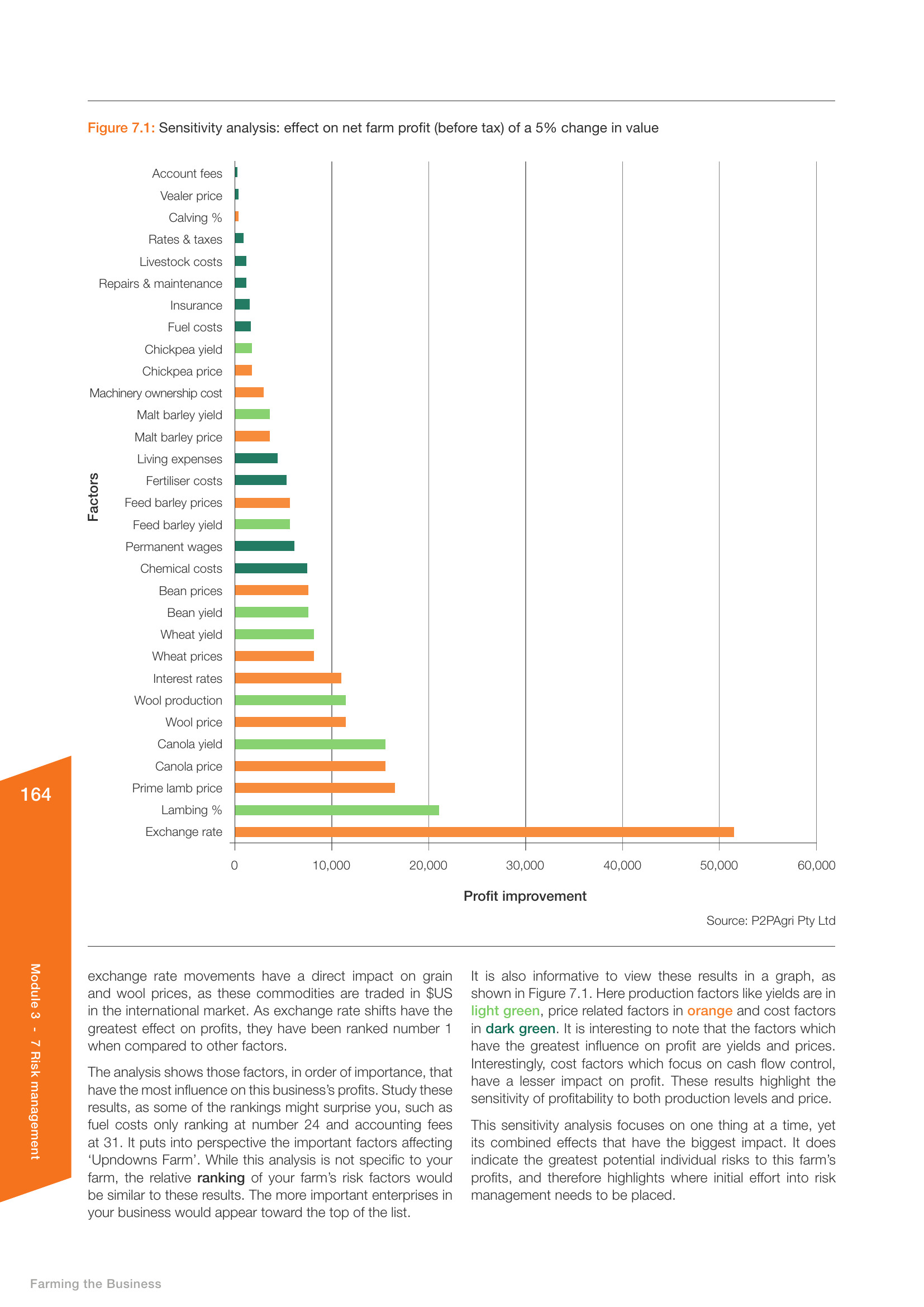
Managing Farm Input Costs When Everything Keeps Rising: A Practical Guide
Managing farm input costs as urea and diesel keep rising: where your money goes, how to calculate your break-even, and three ways farmers protect margins.