How to Build a Farm Cash Flow Forecast: A Season-by-Season Guide for Australian Farms
Ask an AI assistant how to build a farm cash flow forecast and it will usually hand you something written for a farm in Illinois or Herefordshire. The structure is not wrong, but the year is upside down, the tax system is different, and there is no mention of the two things that shape cash hardest on an Australian farm: the gap between sowing a winter crop and being paid for it, and the way GST and the fuel tax credit cycle through your Business Activity Statement.
This is the Australian version. Seven steps, in order, with the seasonal timing that actually applies here.
The seven steps
- Start with the cash you actually have today.
- Map income to the month the money lands, not the month you harvest.
- Time your costs by invoice date, not by when the input is used.
- Decide your GST treatment, then add principal, drawings, PAYG and FMD movements.
- Calculate the closing balance each month and find the low point.
- Rerun it on a poor season.
- Put the actuals in every month and ask why they differ.
Why bother
Three questions get answered by a monthly cash flow and by nothing else. How much working capital does the business need, and when. Whether an input purchase should be funded from the account, from supplier terms or from the overdraft. And whether the business can carry the season if the season disappoints.
None of those can be answered from an annual budget, because an annual budget nets the year off and the trough disappears into the total. A farm that finishes the year with a healthy profit can still be unable to pay for urea in April. Our article on why farm profit and cash flow part company explains how that happens.
It is also the document the bank wants. Lenders use a cash flow to work out at what times during the season the overdraft is required, when it will be at its maximum and how large it is likely to be, and whether you can make loan repayments as they fall due. Those happen to be the same three things you need for your own decisions, so the work is not wasted even if the bank never asks.
Step 1: Start with the cash you actually have
The opening balance is the trading account balance on the day you start, plus any cash at call. On most farms the overdraft is the trading account, so if you are drawn the bank balance is already negative and there is nothing further to subtract. Use the real figure from the bank, not the figure in your head and not the one in last year’s budget.
One trap here. The overdraft limit is not an opening balance. It is a facility. Showing it as available cash is the fastest way to build a forecast that never reveals a problem, because the trough can never go below zero.
Orders you have placed but not yet been invoiced for do not belong in the opening balance either. That money is still in the account. It belongs in the month the invoice falls due, which is what Step 3 is for. Deducting it here as well counts it twice.
Step 2: Map income to the month the money lands
This is where an Australian forecast diverges most from an imported template, and where most of the value is. The question is never when you grew it. It is when the money hits the account.
Winter crop
Harvest runs from around October through to January depending on where you are. The northern wheatbelt in Western Australia and the winter crop in southern Queensland and northern New South Wales can start in late September or early October, several weeks ahead of the south. Payment timing, though, is a marketing decision rather than a harvest date. Grain sold off the header to a cash buyer might pay within a fortnight. A grain pool can take longer than twelve months to complete payment, and the manual puts the final payment as much as eighteen months out, which means a payment from last year’s crop may well land inside this year’s forecast. Warehoused grain pays whenever you decide to price it, which is a genuine planning problem: you have to put a month in, so put in your intended month and stress-test it later.
Livestock
Turnoff timing drives it. Prime lambs, cull ewes, weaner cattle and surplus stock each land in different months, and unlike grain they are generally paid promptly after sale. Wool is separate again, and the sale date rather than the shearing date is what matters.
Everything else
Off-farm income, whether that is a wage, contracting work for neighbours or investment income, is usually the steadiest line in the whole forecast and often the thing carrying the winter months. Put it in. Interest on cash and Farm Management Deposits goes here too.
Farming the Business, the GRDC manual written by P2PAgri’s Mike Krause, lays a sample farm out exactly this way, with each enterprise given its own income row so the timing can be estimated separately.
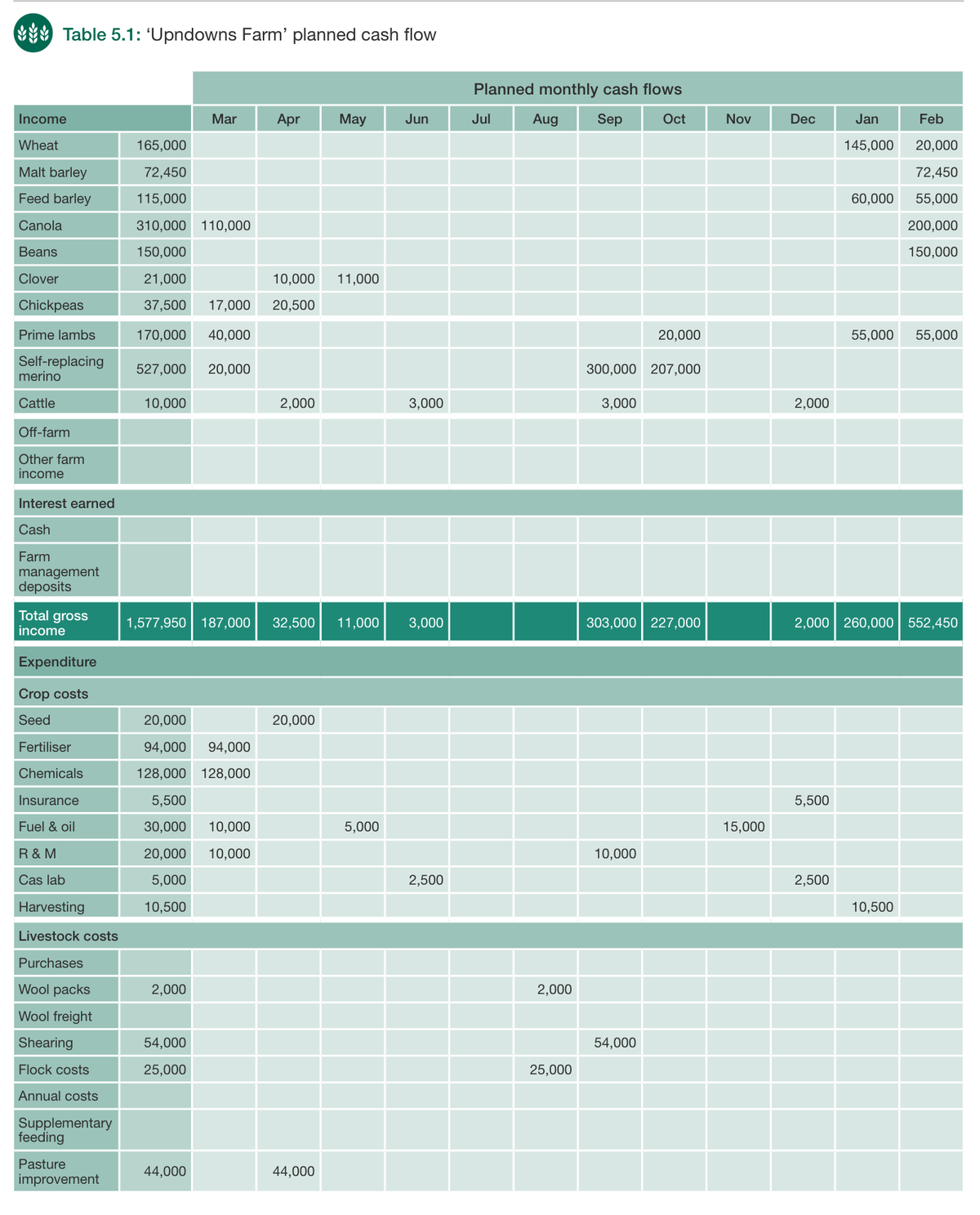
Look at what that table shows: income of $187,000 in March and $32,500 in April, nothing at all in July and August, then $303,000 in September and $552,450 in February. Meanwhile fertiliser and chemical of $222,000 go out in March alone. No annual total tells you that.
Step 3: Time the costs, do not just total them
The same discipline applies to the outgoing side, with one important difference: use the date the invoice is payable, not the date the input goes on the paddock. Urea applied in July that was bought in April on terms to January is a January cash cost, an April commitment, and a July agronomic event. Only one of those three is a cash flow entry.
Group them so you can see the shape:
- Crop costs. Seed, fertiliser, chemical, fuel, contract operations and crop insurance. Levies, receival and freight are usually deducted from the buyer’s payment rather than invoiced to you, so if you have entered grain income at the net figure you actually bank, do not enter them again as outflows.
- Livestock costs. Purchases, feed and supplementary feeding, animal health, shearing and crutching, wool packs, freight and selling costs.
- Overheads. Repairs and maintenance, insurance, rates, electricity, phone and internet, accounting and advisory fees, administration, wages. Many of these are steady monthly amounts, which is exactly why they hurt in the months with no income.
- Capital and finance. Machinery payments, lease payments, loan principal and interest.
Steady overheads plus lumpy income is the structural problem of nearly every farm business. Seeing it laid out month by month is usually the first time it becomes obvious how many months of the year are funded by something other than farm income.
Step 4: Settle your GST treatment, then add the non-cost cash
This is the step that separates an Australian forecast from a translated one, and where a plausible-looking forecast usually goes wrong. Before any of it, set one convention and hold to it, because mixing conventions is what produces a forecast that is confidently wrong.
GST
Start with a decision. Farming the Business is clear that as a general rule GST is left out of farm budgets, and that management budgeting uses GST exclusive numbers. Table 5.1 above carries no GST line at all. That is a perfectly good choice and it keeps the forecast comparable with your gross margins.
The argument for putting it in is that GST moves real money on dates that have nothing to do with your season. You pay it on inputs and claim it back on your next Business Activity Statement. You collect it on sales and remit it later. A farm spending $220,000 including GST on inputs in April has paid $20,000 of GST that comes back through the BAS. That April purchase sits in the April to June quarter, with the BAS due on 28 July, so the refund is realistically four months behind the spend rather than one or two. Equally, the quarter containing your harvest income carries a liability going the other way.
Whichever you choose, the rule is the same: do not mix them. If you carry a GST line, every income and expense row must be entered GST inclusive. If you leave GST out, enter everything GST exclusive. Entering costs excluding GST and then adding the refund on top counts the same money twice and makes the trough look shallower than it is.
One practical lever if you are usually in a refund position, which many cropping businesses are in autumn: you can elect to report GST monthly even when you are under the threshold that would require it. That pulls refunds forward from around four months to about six weeks, which can matter more to the trough than anything else in this section.
Fuel tax credits
Claimed through the same BAS, and for a broadacre farm they are not small. Diesel used in machinery on an agricultural property attracts the full off-road rate with no road user charge deducted, which was 53.7 cents per litre from 3 August 2026. Not every litre qualifies at that rate, though: fuel used in light vehicles of 4.5 tonnes or less travelling on public roads attracts no credit at all, and heavy vehicles on public roads have the road user charge deducted. So the claim is not simply your whole fuel bill times 53.7 cents.
The same convention rule applies here. The manual nets the rebate off the fuel cost, which is the simpler approach. If you do that, do not also enter the credit as a separate BAS inflow.
Tax, drawings and FMDs
PAYG instalments, the annual tax bill, personal superannuation contributions and family drawings all leave the account without appearing as operating costs in a profit budget. Note that employee superannuation is a genuine business expense and does belong in the profit budget as well.
Farm Management Deposits belong here too, and they are one of the few genuinely useful timing tools available: a deposit in a good year takes cash out, a withdrawal in a poor one puts it back. Three conditions decide whether they are available to you at all, and they are worth knowing before you forecast one. Only individuals can hold an FMD, which includes a sole trader, a partner in a partnership or a beneficiary of a trust, but not a company or a trust itself. A withdrawal made within twelve months of the deposit loses the deduction, outside a short list of exceptions such as declared drought or natural disaster. And a withdrawal is assessable income in the year you take it, so it puts cash back and raises that year’s tax bill, which is another line in the same forecast. That combination is exactly why a deposit made for tax reasons in June can create a problem in September.
Step 5: Find the low point
Now do the arithmetic that makes it a forecast rather than a list. For each month: opening balance, plus total inflows, minus total outflows, equals closing balance. That closing balance becomes next month’s opening balance.
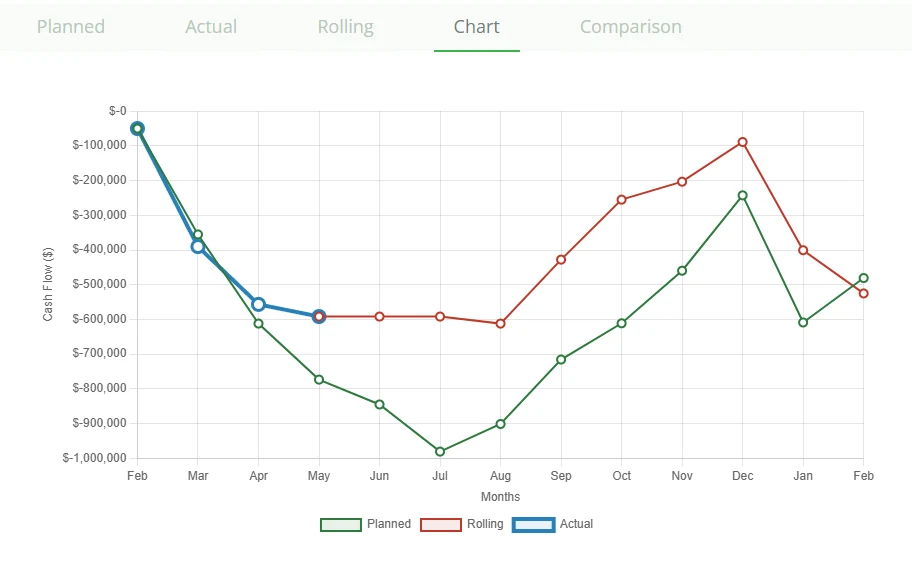
Then read one number off the result: the lowest closing balance of the year, and the month it happens in. That is your peak debt. It is the single most useful figure the exercise produces, and it answers questions that look unrelated to each other.
- How large does the overdraft facility need to be, with a margin on top.
- Whether you can afford to pay for inputs early to capture a discount, or whether you need the supplier’s terms to carry you.
- How much interest the year will actually cost, which is the balance drawn multiplied by the days it is drawn multiplied by the rate, not anything to do with the limit.
- Whether a machinery purchase can be funded in the month it is proposed.
Step 6: Rerun it on a poor season
A forecast built on your expected yield and your hoped-for price tells you what happens if nothing goes wrong, which is the least useful year to plan for. The question worth answering is how much deeper the trough gets when it does.
Test three things separately, because they fail differently:
- Yield. Rerun at a decile 3 yield, or whatever a genuinely poor year looks like on your country. Once the season is under way, P2PAgri shows where the season’s rainfall ranks against every year since 1900, so you can see early whether it is tracking below average. Our guide to budgeting on decile 1, median and decile 9 finishes shows how to turn that ranking into a dry-year case.
- Price. Hold yield and drop price 20 per cent. A price fall and a yield failure are not equivalent shocks, and a poor season in Australia often comes with firmer domestic prices, so test them separately rather than assuming one stands in for the other.
- Timing. The one most easily overlooked. Keep yield and price exactly as planned and simply move the main grain payment two months later. For a lot of farms this does more damage to the low point than a modest yield cut, and it is far more likely to happen.
There is a fourth that belongs on the list for anyone who forward sells. If you have committed tonnes and the yield does not arrive, you may have to wash out or buy back the contract, and that is a large unplanned outflow landing at precisely the moment the trough is deepest. It is probably the single most damaging cash event in a poor year for a marketing-active grower, and it is worth modelling explicitly rather than hoping.
What you are looking for in each case is the new lowest closing balance. If a poor season takes the trough past the overdraft limit, you have found something worth acting on now, while there is time to talk to the bank rather than in the month it happens. Our seasonal planning guide goes further into building a dry-year case.
Step 7: Put the actuals in every month
This is the step that gets skipped, and it is the one that turns the forecast from a document into a management tool. Each month, enter what actually happened beside what you planned, and look at the difference.
Farming the Business makes the point directly: the benefit comes from two steps, a forward estimate of the monthly cash flow followed by recording monthly actuals against those estimated figures. Without the second step you have a budget prepared for somebody else. As the manual puts it, if your estimated monthly cash flow is only being done to meet the bank’s requirements, then the bank may be driving your business rather than you.
The variances are early warning. Income a month late means your trough has moved. A cost 20 per cent over means either a price rise you have not accounted for elsewhere or a volume you did not plan. Either way you find out in month three rather than month nine.
The mistakes that spoil a forecast
- Using the profit budget’s timing. Income recorded when earned rather than when banked makes the trough vanish.
- Mixing GST conventions. Leaving GST out is a respectable choice and the one the GRDC manual recommends. Entering costs excluding GST and then adding the refund as an inflow is not, and it can flatter a month by tens of thousands.
- Carrying depreciation across. It is a real cost and it belongs in the profit budget, but it never moves cash, so it has no place in a cash flow.
- Forgetting loan principal. It is not a cost, so it is not in the profit budget, but it certainly leaves the bank account.
- Forgetting drawings. The family has to live, and in many forecasts this is the largest missing line.
- Treating the overdraft limit as cash. A forecast that can never show a problem is not telling you anything.
- Optimistic payment timing. Assuming everything is paid the moment it is sold. Build in the delay you actually experience.
- Building it once. A forecast not updated against actuals is out of date within a month.
Doing it with the numbers you already have
A spreadsheet will do this. Twelve columns, your own line items, and the closing balance carried forward. If you have never built one, build the first by hand, because the act of deciding which month each payment lands in teaches you more about the business than any tool will.
Software earns its place at the point where you want to run several versions against each other, keep the plan and the actuals side by side without re-keying, and roll the whole thing forward each month rather than rebuilding it. That is what P2PAgri’s cash flow planning does: it builds the monthly forecast from your own figures, pulls actuals through the Xero integration so the comparison happens without data entry, and lets you hold a dry year beside an average one with scenario analysis.
Related reading: our guides to building a farm business plan, knowing your cost of production and what banks look for when lending to farmers.
About the detail here
Rates and rules checked as at 28 August 2026. The fuel tax credit rate of 53.7 cents per litre for off-road diesel applies from 3 August 2026 and is reviewed regularly, so check the current rate before relying on it. Seasonal timings described here are indicative. Harvest starts earlier in the Western Australian northern wheatbelt and in the winter crop of southern Queensland and northern New South Wales than it does further south, and northern summer cropping runs to a different calendar entirely. GST, PAYG and Farm Management Deposit treatment depends on your own circumstances. This is general information, not financial or tax advice.
The short version
A cash flow forecast is a profit budget with the timing put back in, plus the money that moves without ever being a cost, minus the costs that never move money. Build it month by month, map the money to when it actually lands, add principal and drawings, take depreciation out, settle your GST convention and hold to it, then read one number off the bottom: the lowest closing balance and the month it falls in.
Then do the part that matters. Rerun it on a bad year to see how deep the hole gets, and put the actuals in each month so you find out early when the year is not going the way you drew it. A forecast that is never revisited told you something once. One that is updated tells you something every month.