
What Supplier Trade Credit Actually Costs You (Compared With an Overdraft)
Most of what ranks online for farm input finance was published by somebody who wants to lend you money, and it shows. The number that actually decides the question is rarely shown: what your supplier’s terms cost once you convert them into an annual interest rate and put them next to your overdraft.
This article does that arithmetic. There is a catch that most treatments of it get wrong, and it is worth stating up front: a settlement discount and a price premium produce two different breakeven numbers, because one comes off the invoice and the other sits on top of the cash price.
Quick Answer
On a long seasonal term, supplier credit is usually cheaper than an overdraft, but only while the terms price stays close to the cash price. Working an overdraft at 10.72 per cent across a 276 day term:
- The overdraft costs 8.1 per cent of the amount borrowed over that period.
- Price premium breakeven: about 8.1 per cent. If the terms price is more than 8.1 per cent above the best cash price, the bank is cheaper.
- Settlement discount hurdle: about 7.5 per cent. A discount has to beat that before borrowing to pay early makes sense, because you only borrow the discounted amount.
- Short discount windows are a different animal. Two per cent for paying 20 days early annualises to 37.2 per cent, so if you are ever offered one, take it.
The three ways a farm funds its inputs
There are only three sources, and most farms use all three in the same season without ever pricing them against each other.
Your own cash. Money already in the business, or sitting in a prepayment account. It feels free because no invoice arrives for it, but cash in an offset or a deposit is earning something, and spending it gives that up.
Prepayment programs are a special case worth understanding properly. Nutrien’s PrePay Plus pays a 5 per cent per annum reward on the daily balance of prepaid funds, credited monthly. That is a real benefit, but it is not a cash return: the reward is swept to your trading account and must be spent on that supplier’s goods, the prepaid money cannot be withdrawn, and it has to be used within 12 months. Treat it as a discount on future purchases in exchange for locking capital up with one supplier for a year, not as an interest rate. As the bargaining power section below explains, that lock has its own cost.
Supplier terms. The trading account with your reseller. Nutrien Ag Solutions’ published trading account terms make payment due on the earlier of the due date set out in the invoice or, where the invoice does not set one, within 30 days, reduced to 14 days for livestock transactions, with a default interest rate applying to overdue amounts. The long seasonal terms farmers think of as standard come from the date negotiated onto the invoice, not from the default position in the terms and conditions. Check what your invoices actually say before assuming the credit runs to January.
The bank. An overdraft or seasonal working capital facility. NAB’s business overdraft benchmark rate was 10.72 per cent per annum effective 31 August 2026, and the RBA’s indicator lending rate for small business variable overdrafts was 10.51 per cent at April 2026 and rising, against a cash rate held at 4.35 per cent on 11 August 2026. Concessional term lending is cheaper again: Regional Investment Corporation loans moved from 5.18 to 5.71 per cent variable on 1 August 2026, though RIC is a Commonwealth concessional lender with restrictive eligibility, and by its own account prices around 2 per cent below comparable commercial rates. Commercial farm term debt sits between the two.
Turning a discount into an annual interest rate
A settlement discount is the price of money, quoted backwards. When a supplier offers 2 per cent off for paying early, they are telling you what they will pay you to lend them your cash between the early date and the due date. To know whether that is a good rate, annualise it.
The formula
Annualised cost of giving up the discount = [ D ÷ (100 − D) ] × [ 365 ÷ days paid earlier ]
where D is the discount percentage and days paid earlier is the number of days between the discount date and the date the money would otherwise be due. The divisor is (100 − D) rather than 100 because the discounted price is what you would actually be financing. The second bracket decides the answer, and it is the one everybody ignores.
Run it twice with the same discount and the point becomes obvious.
| Offer | Days paid earlier | The arithmetic | Annualised |
|---|---|---|---|
| 2% for paying within 10 days, otherwise due at 30 days | 20 | (2 ÷ 98) × (365 ÷ 20) | 37.2% p.a. |
| 2% for paying by 30 June, otherwise due 31 January | 215 | (2 ÷ 98) × (365 ÷ 215) | 3.5% p.a. |
| 3% for paying by 30 June, otherwise due 31 January | 215 | (3 ÷ 97) × (365 ÷ 215) | 5.3% p.a. |
| 5% for paying by 30 June, otherwise due 31 January | 215 | (5 ÷ 95) × (365 ÷ 215) | 8.9% p.a. |
The same 2 per cent is worth 37.2 per cent per annum in one row and 3.5 per cent per annum in another. Nothing about the discount changed. Only the length of the credit it replaces.
This is why advice imported from American textbooks can mislead. The standard example there is “2/10 net 30”, built on 30 day commercial terms, where forgoing a discount really is ruinous. It is a US construction and we have not seen it offered as standard by Australian ag resellers, so treat it as a worked illustration of the method rather than a deal to go looking for. Where seasonal input terms run for the better part of a year, a small discount is simply not worth much per annum.
A worked comparison on a $200,000 input bill
Take a mixed farm with $200,000 of fertiliser and chemical invoiced on 30 April, on terms to 31 January. That is 276 days of credit. This is an assumption rather than a rule, and it is the single most load-bearing number in the article: check your own invoice dates, because if your terms are 30 days the conclusions below reverse completely. Assume an overdraft at 10.72 per cent, and surplus cash that would otherwise earn 4.35 per cent, which is the RBA cash rate used here as a deliberately generous proxy, since most at-call business deposits pay less.
| Option | What it costs over 276 days | Cost |
|---|---|---|
| Take the supplier terms, pay 31 January | No interest. Any price premium is extra, and is dealt with below | $0 in interest |
| Borrow on overdraft, pay the supplier 30 April | $200,000 × 10.72% × 276 ÷ 365 | $16,212 |
| Use your own cash, pay the supplier 30 April | $200,000 × 4.35% × 276 ÷ 365 of forgone return | $6,579 |
Now add a 2 per cent settlement discount for paying on 30 April. It is worth $4,000, and it changes what you have to find: you now pay $196,000, not $200,000, so that is what you borrow. Interest on $196,000 over 276 days at 10.72 per cent is $15,888, against a $4,000 saving, leaving you $11,888 worse off. Funding it from your own cash gives up $6,447 of return, so you are still $2,447 worse off. Taking the terms and paying on 31 January costs no interest at all.
Two thresholds, not one
At 10.72 per cent over 276 days an overdraft costs 8.1 per cent of the amount borrowed. That single percentage produces two different tests, because a discount and a premium are measured against different bases:
- Settlement discount hurdle, about 7.5 per cent. A discount comes off the invoice, so you finance the smaller amount. The breakeven is 8.1 divided by 1.081.
- Price premium breakeven, about 8.1 per cent. A premium sits on top of the cash price, and you would finance the full cash price, so the breakeven is the overdraft cost itself.
For your own numbers, the overdraft cost is your rate multiplied by the days of credit divided by 365. The discount hurdle is that figure divided by one plus that figure.
Why the answer changes with your peak debt month
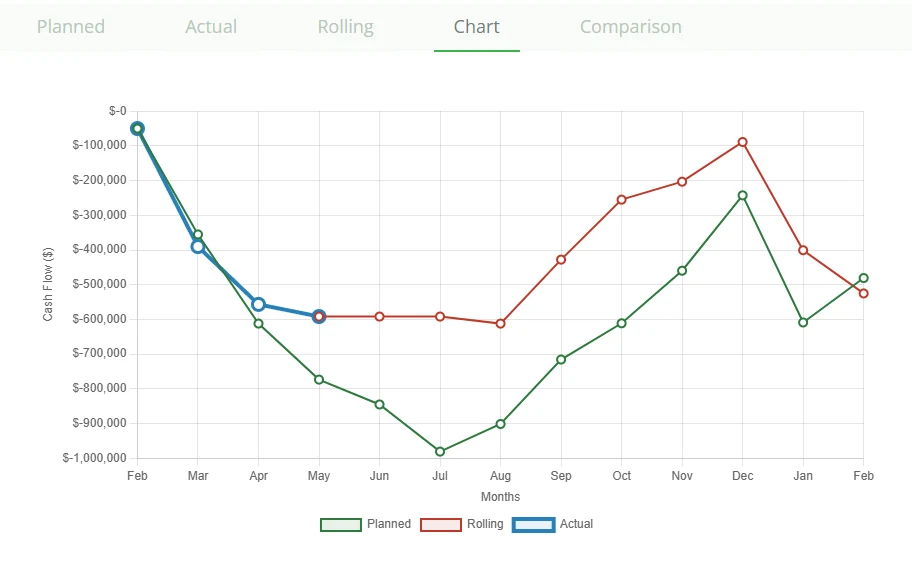
Everything above assumes you would actually be drawn on the overdraft for the full 276 days. Often you would not. An overdraft does not cost you its limit, it costs you the balance actually drawn multiplied by the days it is drawn, so the real comparison depends on where the input bill sits relative to the rest of your year.
If your grain payment lands in December and the input bill is not due until the end of January, the terms are carrying you across a gap you were never going to have to borrow for anyway, and their value is close to zero. If your low point is in October, three months before the invoice falls due, the terms are doing real work and the comparison above understates them.
This is why the question cannot be answered from an annual budget. An annual budget nets the whole year off and shows a farm that is profitable and solvent. The trough is invisible in it. You need the monthly closing balance.
What supplier credit quietly costs you in bargaining power
The arithmetic so far assumes the price is the same whether you pay in April or January. Frequently it is not, and this is where the real cost of supplier credit hides. It is not charged as interest. It is charged as price, and price is much harder to compare.
A large balance sitting on one account narrows your practical ability to take the next order elsewhere and ask somebody to sharpen a quote. That is worth something to the supplier, and what it is worth to them is what it costs you. A prepayment program tightens the same knot, which is why the 5 per cent reward and the bargaining cost need to be weighed together rather than one at a time.
To annualise a premium, note that it is a percentage of the cash price you would otherwise have borrowed, so the arithmetic is simply the premium multiplied by 365 divided by the days of credit. No (100 − D) divisor here, because nothing has been taken off the invoice.
| Terms price above the best cash price | Annualised over a 276 day term | Verdict against a 10.72% overdraft |
|---|---|---|
| 2% | 2.6% p.a. | Terms much cheaper |
| 4% | 5.3% p.a. | Terms cheaper |
| 8.1% (the breakeven) | 10.7% p.a. | Line ball |
| 10% | 13.2% p.a. | Overdraft cheaper |
The practical move is not to abandon your reseller. It is to get a cash price and a terms price on the same order, at least once a season, so the spread between them stops being invisible. If you have never asked, you do not know which row of that table you are in, and neither does anybody writing about it.
How much working capital a farm actually needs
The funding question sits inside a bigger one: how much working capital the business needs at all. The answer is the depth of the deepest trough, plus a margin for the season disappointing you.
Farming the Business, the GRDC manual written by P2PAgri’s Mike Krause, puts the point bluntly in the context of taking on country. A 500 hectare lease at $200 per hectare payable in advance is $100,000. Sowing all of it to wheat at $300 per hectare is another $150,000. The minimum working capital required is $250,000, spent before a single grain is sold, and the manual’s question is the right one to ask before any expansion: will your bank extend your overdraft by $250,000 to support this?
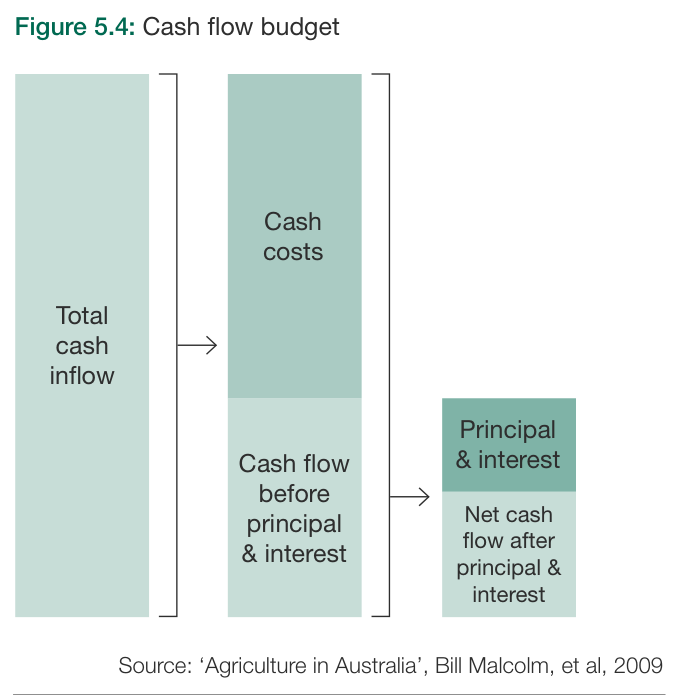
The manual also sets out why a bank wants the monthly version rather than the annual one. Lenders use a cash flow to assess at what times during the season the overdraft is required, when it will be at its maximum and how large it is likely to be, and whether the business can make loan repayments as they fall due. Those are the same three things you need in order to price your input funding, which is a useful coincidence: the document that answers the bank’s question also answers yours.
Finding your peak debt
None of this requires sophisticated software. It requires a monthly cash flow with your actual numbers in it, and the discipline to update it as the season moves rather than building it once for the bank in February and never opening it again.
What you are looking for is one line: the closing bank balance, month by month, for the next twelve months. The lowest point on that line is your peak debt. The month it happens in tells you how long you would really be borrowing for, which is the missing input in every calculation above. Once you have it, you can test the input funding decision as a scenario rather than a hunch, and see the effect on the trough rather than on the annual profit.
That is what P2PAgri’s cash flow planning is built to do, with scenario analysis to compare funding options side by side, and Xero integration so the actuals arrive without re-keying. The tool matters less than the habit. What matters is that the decision stops being made on the day the invoice arrives and starts being made against a picture of the whole year.
Related reading: our guides to managing farm input costs, what healthy farm debt looks like and what banks look for when lending to farmers.
About the numbers
Rates checked as at 2 September 2026: NAB business overdraft benchmark 10.72 per cent effective 31 August 2026; RBA indicator lending rate for small business variable overdrafts 10.51 per cent at April 2026; RBA cash rate 4.35 per cent, held 11 August 2026; Regional Investment Corporation concessional loans 5.71 per cent variable from 1 August 2026. Rates move, so check them again before you rely on them.
The worked example uses simple interest for clarity. A real overdraft charges interest monthly on the debit balance, so it compounds: the $16,212 above would be closer to $16,800 compounded monthly. Most business overdrafts also carry a line or facility fee charged on the limit whether you draw it or not. Both of those make the overdraft slightly worse than shown. This is general information, not financial advice.
The short version
On a long seasonal term, supplier credit is usually the cheaper money, provided the terms price is no more than about 8 per cent above the best cash price you could negotiate. That proviso is doing a lot of work, and it is the part almost nobody measures. Until you have asked for both prices on the same order, you do not actually know whether your supplier credit is cheap or expensive, and the honest answer is that neither do we.
What the arithmetic does settle is the shape of it. A small discount spread over most of a year is a low annual rate, so borrowing to capture it is usually a losing trade, while a discount on a ten day window is a very high rate and worth taking. The percentage never tells you which is which. The days do. And none of it can be priced at all until you know which month your cash position bottoms out, because that is what decides how long you would actually have been borrowing for.