
Farm banking in Australia is a bigger decision than the rate on the offer letter. The lender you choose sets what your money really costs, how much room you get in a bad year, and whether the person reading your file knows when you sow and when you get paid. Yet plenty of farmers still bank where their father banked, and review it about as often.
That habit costs more than it used to. As at November 2026 the Reserve Bank cash rate is 4.85 per cent after five rises this year, and ABARES reported in March 2026 that lending to the farm sector reached $142.5 billion in 2024-25. A quarter of a point of margin on $2 million of debt is $5,000 a year, every year.
P2PAgri is not a bank and not a broker, and earns nothing from anyone’s loan, so this guide does not rank banks. It gives you a way to compare them, drawing on chapter 6 of Farming the Business, the GRDC manual I wrote with input from Tony Hudson of Hudson Facilitation, and on four years I spent as an economist inside a bank.
Quick Answer
There is no single best bank for farmers. The right farm bank is the one whose all-in cost, facility structure, covenants, security terms and people suit your business. To find it, ask your current bank and two or three others for written offers on the same structure, compare total annual cost rather than headline rate, and let your own bank respond before you move.
- Your rate is a base rate plus a customer margin. The base rate is not negotiable. The margin, and most bank fees, are.
- Switching costs are real. Break costs, legal fees, valuations and registration fees add up, though no state now charges stamp duty on a mortgage.
- A broker can earn their keep on a large or complex deal, but is usually paid by the lender. Ask how, and whether they earn more if you switch.
About the detail here
Checked as at 19 November 2026: the 4.85 per cent cash rate after the Reserve Bank’s 3 November decision, the 5.71 per cent RIC rate that applies from 1 August 2026, and the 2025 Banking Code of Practice, in force since 28 February 2025. Worked example figures are illustrative, not quotes or market averages, and exclude GST. General information, not financial or legal advice: take refinancing, security and loan decisions to your accountant, adviser or lawyer.
What is farm banking?
Farm banking, or agricultural banking, is the set of loans, overdrafts and deposit accounts a farm business uses to fund land, working capital and equipment. For most broadacre and mixed farms that means term loans for land, an overdraft or seasonal limit to carry the business from sowing to harvest, equipment finance, and somewhere to hold cash and Farm Management Deposits. Agribusiness loans are not home loans: they are priced customer by customer, carry covenants and reviews, and are usually secured over the whole farm.
Banks for farmers: the six kinds of agricultural lender in Australia
Farmer banking is no longer a choice between the two banks in the main street. Six kinds of lender now compete for farm business.
| Type of lender | What it does | What to check |
|---|---|---|
| Major bank agribusiness divisions | The full range of farm facilities, with relationship managers in regional centres | Who approves credit and where they sit; how long your banker is likely to stay |
| Specialist agribusiness bank | Lends mainly to agriculture and the food chain, so farming is its core business rather than one division | The same as any bank |
| Regional and customer-owned banks | Regional banks, mutual banks and credit unions, some with agribusiness teams | Appetite for the size of your debt; which code of practice it follows |
| Non-bank agricultural lenders | Private credit funds and specialist finance companies that may lend where, when or how a bank will not | The all-in rate, every fee and the exit costs; it is not bound by the Banking Code |
| Stock and station agent finance | Trade accounts, seasonal input finance and livestock finance alongside what you buy and sell | The true annual rate; how it sits beside your bank’s security and limits |
| Regional Investment Corporation (RIC) | The Australian Government’s farm lender, with concessional loans for eligible farm businesses | Eligibility, and how a RIC loan fits around your commercial facilities |
A description of lender types, not a ranking. P2PAgri does not recommend or rate individual lenders.
Stock agent credit is easy to take and easy to underprice, and banks now want it on your cash flow; our comparison of supplier trade credit and the overdraft shows how to work out its real rate. And RIC’s variable rate has been 5.71 per cent since 1 August 2026, about 2 percentage points below comparable commercial lending by its own estimate.
How to choose a farm bank: what to compare beyond the interest rate
The manual’s advice still holds: compare the interest rate and all the fees, then the services, because some services can matter as much as the savings.
| Compare | What to ask for | Why it matters |
|---|---|---|
| Customer margin | The base rate and your margin for each facility, in writing | The margin is the negotiable part of the rate |
| Fees | Every establishment, line, limit, account, review and valuation fee, as annual dollars | Fees can make the lower headline rate the dearer deal |
| Facility structure | The split between term debt, overdraft, seasonal limits and equipment finance; fixed and variable options | The wrong structure can cost more than a higher margin |
| Covenants and reviews | Every financial covenant, how it is calculated, and how often facilities are reviewed and renewed | A covenant breach in a poor year changes the conversation |
| Security and valuation | What security is taken, the loan to value limit, how often land is revalued and who pays | Security sets your margin and how easily you can move later |
| FMD offset | Whether Farm Management Deposits can offset your farm debt | Not every lender offers it |
| Relationship manager | Who your banker would be, where they are based, how long they have been in the role, who approves credit | Continuity and local knowledge show up in a bad season |
| Hardship and drought | Whether it subscribes to the Banking Code, and who manages a farm account in difficulty | You find out how a lender behaves when you can least afford to move |
The rate: base rate plus your customer margin
A farm lending rate is a base rate plus a customer margin. The base rate covers the bank’s cost of funds, operating costs and return to shareholders, and moves with the Reserve Bank. The customer margin is the bank’s price for the risk it sees in lending to you. In the manual (section 6.1.2) I set out how banks arrive at it: four of the “five Cs”, cash flow, character, capital and conditions, are rolled into a customer rating, and the fifth, collateral, is scored as a loan to value ratio and a security category.
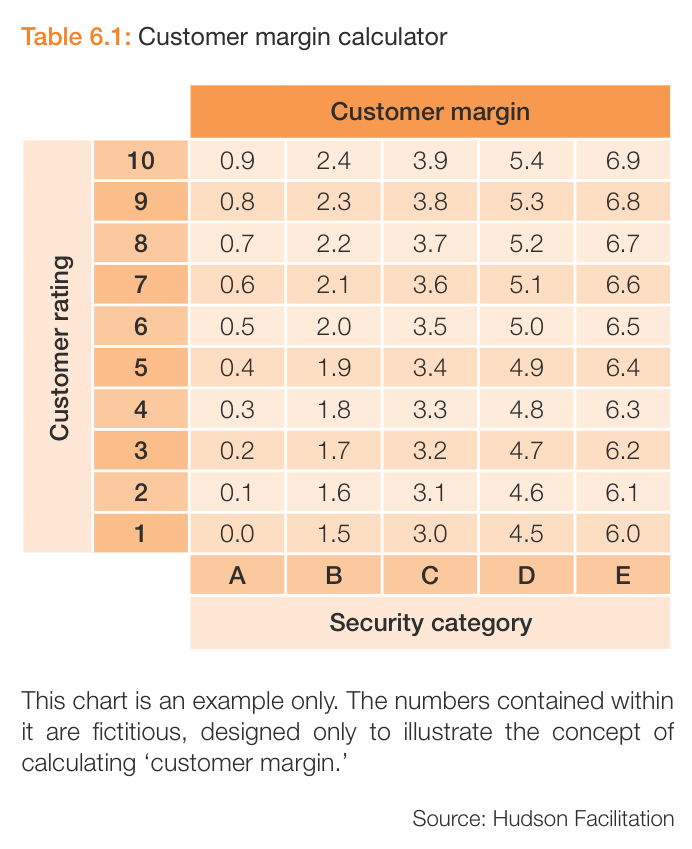
The manual’s case study shows what is at stake. A farmer owing $700,000 against a $2 million farm has a loan to value ratio of 35 per cent, security category B, and on a customer rating of 4 pays a 1.8 per cent margin. Offering another $400,000 of real estate as security moves them to category A and a 0.3 per cent margin: $10,500 a year saved on the same loan. Our guide to stress-testing a farm budget for higher interest rates works through what the margin is worth on today’s numbers.
Ask every lender for the base rate and margin separately, and ask what your customer rating is and what would improve it. As the manual says, “Customer margins and fees are negotiable, except for government fees.”
Fees: the cost that hides behind the headline rate
Former big-four agribusiness banker Matt O’Dea, now a finance broker, put it bluntly on our podcast about farm lending after the Royal Commission. Lenders name their fees differently, from line fees to quarterly management fees and undrawn limit fees, and “you think you’re paying 7%, but once you add everything else on, it’s probably closer to 8%.”
Ask each lender for every fee as an annual dollar figure and add it to the interest. A line fee is usually charged on the limit, not the balance, so an overdraft limit you rarely touch can cost more in fees than in interest.
Facility structure: term debt, overdraft and seasonal limits
Structure is where many farm businesses overpay without noticing. An overdraft tends to carry a higher base rate than a fully drawn term loan, so long-term debt parked on the overdraft costs more every day. Matt O’Dea still sees clients “with 80% of their debt sitting on an expensive overdraft and only 20% on the cheaper term loan, when it should be the other way round.”
So compare how each lender would structure the same debt: the term and amount of term debt, the seasonal limit and when it peaks, and whether part can be fixed. A line of credit that combines seasonal and long-term debt is flexible, and needs discipline, because nothing forces the balance back to zero after harvest.
Covenants, reviews and valuations
A covenant is a condition in your loan agreement, often a minimum ratio such as interest cover or equity, that you must keep meeting. Ask how each is calculated, how often it is tested, and what happens if you miss it in a poor year. Ask too how often land is revalued and who pays: in Matt O’Dea’s experience, banks now want an updated valuation roughly every three years.
The relationship manager, and who actually says yes
I wrote in the manual that “the front-line banker you know and developed a relationship with may not be the bank officer making the final lending decision on your loan request.” With credit now centralised, often interstate, your banker’s job is to explain your business to people who have never seen it. Continuity is scarce: Matt O’Dea says that if your banker has been your manager for longer than two years, “or even twelve months these days, you’re doing quite well.” When his clients tender their banking he weighs “the actual proposed banker for the deal”, not just price.
Farm Management Deposit offset
Since 1 July 2016 the tax law has allowed a Farm Management Deposit to offset a loan of the owner’s own primary production business, which in practice means sole traders and partnerships rather than farms run through a company or trust. Not every lender offers it, so if you hold FMDs, put it on the list, and ask your accountant how it applies to your structure. Our guide to how much to put in a Farm Management Deposit explains how an offset works.
What the Banking Code of Practice says about farm lending
The Banking Code of Practice is the Australian Banking Association’s code of conduct for its member banks. The current version, approved by ASIC in June 2024, has applied since 28 February 2025. Before you rely on it, check two things.
Is your business covered? The Code applies to individuals and small businesses, and their guarantors. Under the 2025 Code, a business is small if, with any related businesses, it had turnover under $10 million last financial year, has fewer than 100 full-time equivalent employees, and owes less than $5 million in total to all credit providers, counting undrawn limits and any loan being applied for (up from $3 million in the previous Code). Plenty of broadacre businesses owe more, and above that line your loan contract, and in some states the farm debt mediation law, does most of the work.
Does your lender subscribe? ABA member banks with a retail presence must sign up. Non-bank lenders are not bound by it, and many customer-owned banks follow the Customer Owned Banking Code instead.
For farmers inside it, the 2025 Code commits subscribing banks to:
- No default interest in drought or natural disaster. No default interest, or a fee in its place, on a farming loan while the land is in a drought or natural disaster declared by a state or territory government, or the bank is otherwise satisfied of it. You may need to tell the bank, and any already charged is refunded.
- Farm debt mediation and AFCA. Before farm debt mediation the bank must tell you that you may have a right to complain to the Australian Financial Complaints Authority, and if mediation fails it will consent to AFCA hearing the complaint.
- Notice periods. For a small business loan not in default, at least three months’ notice of a decision not to extend it, and at least 30 days’ notice of a payment default before the bank demands full repayment or enforces, with limited exceptions. An overdraft or other on-demand facility is one: the bank may call it in without that notice.
- Limits on non-monetary defaults. Only listed, material defaults count, usually with at least 30 days to fix them, and no general “material adverse change” clause in standard small business loans.
- Valuations and hardship. A copy of any agricultural property valuation you paid for, and help in financial difficulty, which the Code says can be caused by drought, such as interest-only periods, a longer term or deferred repayments.
Questions to ask about hardship before you sign
Banks do not all behave the same way when a farm gets into trouble, and as the manual says, “it is difficult to say which banks are the hardest on farmers who find repayments difficult.” A bank’s approach can change over the seasons with its view of agriculture and its exposure to your sector and region. Matt O’Dea tells of a broadacre farmer in a bank’s workout division whose facilities were all set to expire in September: crop in the ground, money spent, no income until harvest at Christmas. So ask while things are good:
- Who would manage my account if it got into difficulty, and where are they based?
- When do my facilities expire, and can that be after harvest rather than in the middle of the season?
- Do you subscribe to the Banking Code, and is my business a small business under it?
- What did you do for farm customers in this district in the last drought?
Worked example: comparing two farm bank offers on all-in cost
An illustrative farm business has a $2 million term loan at 7.75 per cent and a $500,000 overdraft limit at 8.5 per cent, averaging $200,000 drawn. It gets an offer with a lower headline rate, then asks its own bank to respond.
| A year of farm banking | Current deal | Offer from a new lender | Current bank’s response |
|---|---|---|---|
| Term loan rate on $2,000,000 | 7.75% | 7.40% | 7.50% |
| Overdraft rate, averaging $200,000 drawn | 8.50% | 8.30% | 8.25% |
| Interest | $172,000 | $164,600 | $166,500 |
| Line fee on the $500,000 overdraft limit | $5,000 (1.0%) | $7,500 (1.5%) | $5,000 (1.0%) |
| Account and management fees | $2,000 | $3,000 | Waived |
| Total annual cost | $179,000 | $175,100 | $171,500 |
| All-in rate on $2.2 million average borrowings | 8.14% | 7.96% | 7.80% |
| One-off switching costs, spread over 4 years | Nil | $3,000 a year ($12,000) | Nil |
| Saving against the current deal | $900 a year | $7,500 a year |
Illustrative figures, not quotes or typical market rates, excluding GST. All-in rate is total annual cost divided by average borrowings. Switching costs are spread over four years, the top of the manual’s three to four year tender cycle.
The new lender’s lower rates save $7,400 a year in interest, $7,000 of it from a term rate 0.35 of a point lower. After its higher fees the saving is $3,900, and after switching costs it is $900. The current bank cut its margins by a quarter of a point and waived its management fees: $7,500 a year, with no switching costs.
Staying does not always win. If your bank will not move, or the new lender offers a better structure or covenants you can live with in a drought, the numbers can run the other way. The point is the method. Banks find it easier to keep a customer than to replace one, and as the manual says, “This is your negotiating strength!”
Should I use a broker for my farm loan?
Matt O’Dea estimates brokers did about one in ten agricultural loans when he started broking, just over six years before our interview, and about four in ten now, “rapidly approaching five in ten.” Most of what you will read on this question is written by brokers. Here is the neutral version.
How agri brokers are paid
Most agricultural finance brokers are paid by the lender: an upfront commission when a new loan settles and a trail commission while it stays in place. Some also charge the farmer a fee. Matt O’Dea was candid about the incentive: “as a finance broker I get paid more if clients change banks, because we get an upfront fee, whereas if they stay we only get a trail commission on their existing loans.” That does not make brokers bad advisers. It means you should know how yours is paid.
Does the best interests duty apply to farm loans?
Generally, no. Since 1 January 2021 mortgage brokers have had a legal duty to act in the best interests of consumers, but it sits in the National Consumer Credit Protection Act and covers credit regulated by the National Credit Code. ASIC’s guidance on the duty (RG 273) ties it to consumer credit: broadly, lending to individuals for personal, domestic or household purposes or residential investment property. A farm business loan is business-purpose credit, so in general the duty does not cover it. A good broker may work to that standard anyway. Ask them to say so in writing.
| Your situation | Usually better | Why |
|---|---|---|
| Good relationship, simple needs, you want a sharper price | Direct | Your own bank may match without the cost of moving |
| You want several lenders to compete but lack the time | Broker | Running a tender is their job |
| Large or complex deal: a land purchase, several entities, succession | Broker, or an adviser and direct | Writing a credit paper that suits the credit team is a skill |
| Your bank has said no, or you are in its workout division | Broker or adviser | They know which lenders have appetite now |
| You know your numbers and enjoy negotiating | Direct | You keep control, and no commission rides on the outcome |
General guidance, not a recommendation for any individual business.
A broker’s core job, in Matt O’Dea’s words, is to write the credit paper “to appease the credit manager, not your local banker.” Before you engage one, ask:
- How will you be paid on this deal, and by whom?
- Do you earn more if I switch than if I stay?
- Which agricultural lenders are on your panel, and which are not?
- Will you include my current bank’s best offer in the comparison?
- Can I see the credit submission before it goes?
- What do you do after settlement, at reviews and renewals?
Switching farm banks: what it really costs
The manual warns that moving banks can carry “considerable expense in the form of government and bank charges. While bank charges can be negotiated, government charges are fixed.” The usual items:
- Break costs on a fixed rate loan or rate hedge closed early. They depend on where rates have moved, so get a written figure close to the switch date.
- The new lender’s establishment fees.
- Valuations. In Matt O’Dea’s experience the new bank will often cover the valuation on a refinance. Ask.
- Legal costs for the new security documents and the discharge of the old.
- Government registration fees to discharge the old mortgages and register the new ones on every title, plus any registrations over equipment or stock.
One cost has gone. No Australian state or territory now charges stamp duty on a mortgage: New South Wales was the last to abolish mortgage duty, from 1 July 2016. Transfer duty on buying land is a separate tax and still applies.
Ask the new lender, in writing, which costs it will absorb; the manual notes a keen bank may cover some or all of them. If your Farm Management Deposits sit with the bank you are leaving, ask both banks and your accountant how they move before anything is withdrawn, because an unplanned withdrawal can have tax consequences.
How to put your farm banking out to tender: six steps
“Some farming businesses put their finance business up for tender every 3 to 4 years as standard management practice,” the manual says. This works whether you go direct or through a broker.
Step 1: Get your own numbers bank-ready
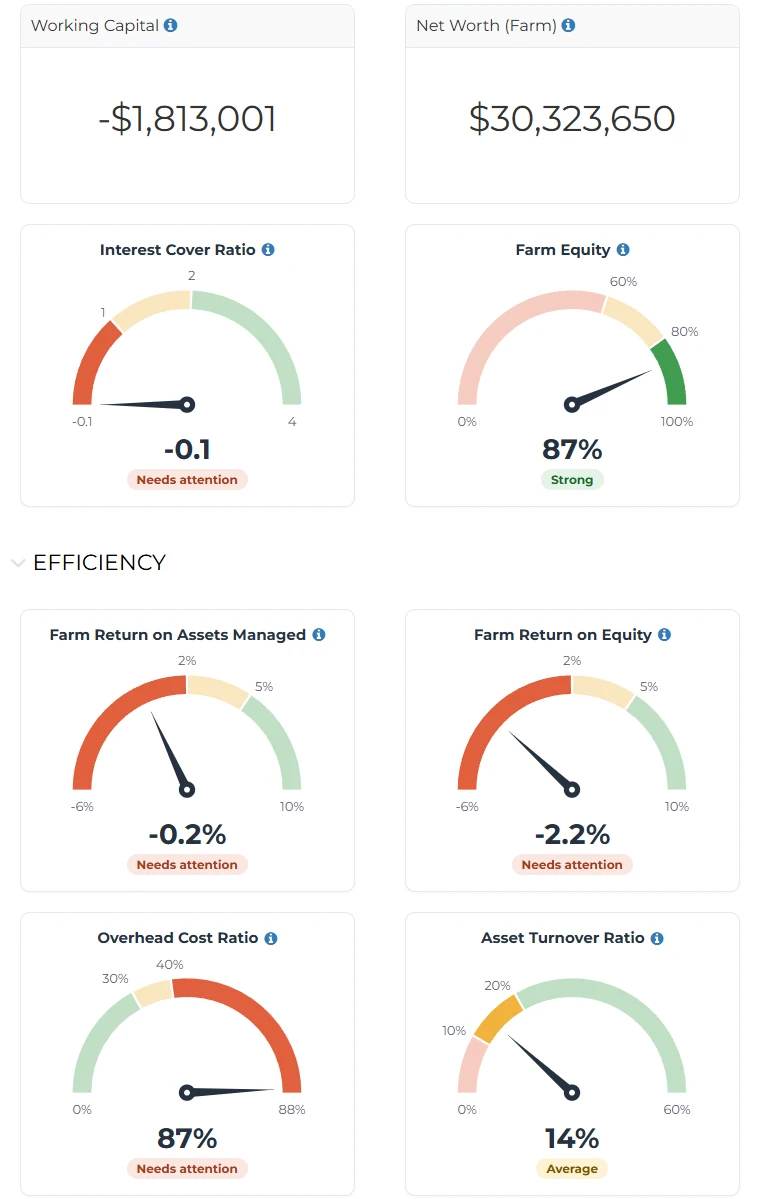
Every lender, and every broker writing for one, needs the same pack: a management profit and loss, a current balance sheet, your key ratios with their trend, a monthly cash flow budget showing the peak overdraft and its month, and a three to five year plan. See what banks look for when lending to farmers and our farm business plan for the bank guide. For ratios, start with the manual’s short list.
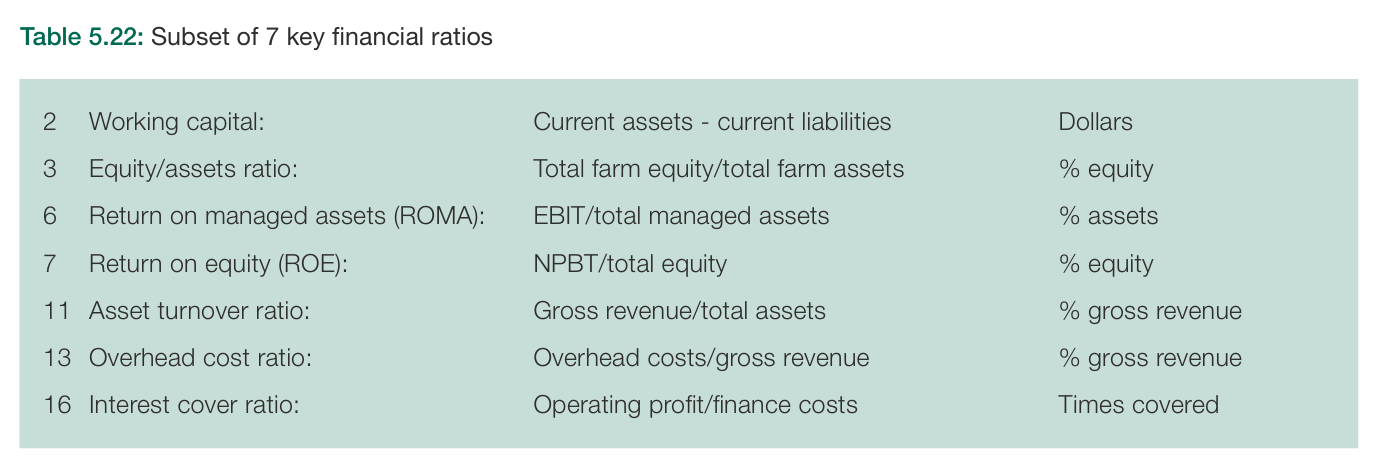
You do not need a paid plan to see where you stand. The free Essentials plan in P2PAgri builds a management profit and loss, a balance sheet and the key bank ratios, with dials and trend charts, from your Xero data or a MYOB import. The monthly cash flow budget is on the Season plan, and five-year projections and side-by-side scenarios are on the Future plan.
Step 2: Write down exactly what you have now
List every facility: limit, balance, base rate, margin, fees, security, covenants, fixed periods, break costs and the next review date. If you cannot fill it in, ask your bank for a written facility summary. You cannot compare an offer against a deal you cannot describe.
Step 3: Decide what you need from a lender
Write down the structure you want, the peak you need to fund and when, whether you want an FMD offset, and what matters beyond price, such as the manual’s list: fixed and variable options, flexibility in security, access to a business banker, and how many reviews are required.
Step 4: Ask for written offers on the same structure
Ask your current bank and two or three others, directly or through a broker, for indicative terms in writing, covering every row of the comparison table above. Offers on different structures cannot be compared.
Step 5: Compare all-in cost and terms, not the headline rate
Work out total annual cost and the all-in rate as in the worked example, with switching costs spread over the years to your next tender. Then weigh what the numbers do not show: security, covenants, reviews and the people.
Step 6: Give your current bank the chance to match, then decide
Take the best written offer back to your current bank and ask for its best response. But do not bluff. As I said on our podcast about what banks look for, if you tell the bank you will shop around and never do, it learns you will not follow through. If you do move, get every switching cost in writing first, and time the move away from your overdraft peak and, if you can, for the end of a fixed rate period so you avoid break costs. Our page on getting the best deal from your bank has Tony Hudson’s guide to the negotiation itself.
The short version
There is no best bank for farmers, only the right lender for your business at the time. Compare what you will actually pay, margin and fees together, on the same structure. Then compare what only shows up in a bad year: covenants, security, hardship provisions and the people. Know how any broker is paid, and let your own bank respond before you pay the costs of moving.
Whichever way you go, the farmer who walks in with a cash flow budget, a balance sheet, ratios and a plan is a lower risk than one who does not, and a lower risk earns a lower margin.
Keep reading

Rural Banking – Beyond the Royal Commission
Rural banking beyond the Royal Commission: Mike Krause on how bank lending to farmers has changed and how to approach interest rate negotiations.

Securing Farm Finance: What the Banking Royal Commission Means for You
Securing farm finance after the Banking Royal Commission: how to prepare for tighter credit and what banks assess when reviewing farm loan applications.
How Much Should You Put in a Farm Management Deposit?
How much should you put into an FMD? Size a farm management deposit after harvest on the rules, tax averaging and your cash low point, with a worked example.