
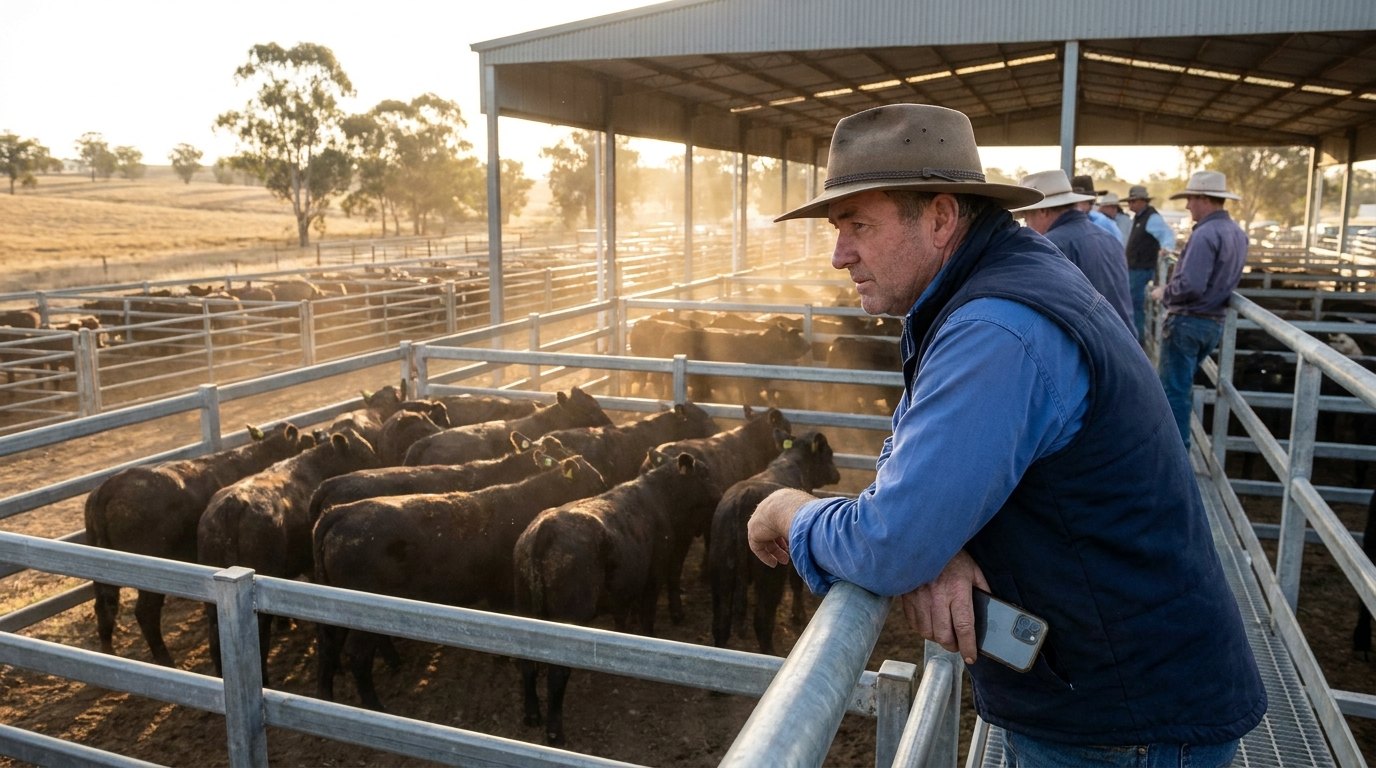
The auctioneer is two pens away and moving fast. In front of you is a line of steers you like. You have a buy price in your head, a sale price you hope for, and about ninety seconds to decide how much to pay for trade cattle that will be on your grass, and on your overdraft, for the next five months.
Most of us do that sum in our heads, and most of us do half of it. Buy price, sale price, the gap looks healthy, the hand goes up. What gets left out is every cost between the two sales, and those costs can take two thirds of the gap.
This article sets out the whole sum: what goes into a cattle trading margin, how to work backwards from the sale to your top bid, and which numbers move the result most. It also explains why we built a pen calculator into P2PAgri to do the sum on your phone at the yards, and why every pen you buy is worth recording through to the day it sells. The aim is a bid you can stand behind.
Quick Answer
The most you can pay for trade cattle is the sale price you expect, less the costs of buying, holding and selling them, less the margin you want. In the worked example below, steers that look to have $540 a head in them leave $171.56 after costs, and the top bid for a $100 margin is $1,329 a head.
- Count every cost between the two sales. Levy, freight both ways, animal health, agistment or pasture, feed, stock loss, interest, commission and yard dues.
- Work backwards, before the sale. Start from the sale you expect and the margin you want, and the sum gives you a top bid to take to the rail.
- Record each pen you buy. A pen tracked from the day it is bought to the day it is sold tells you what you really made, and whether your next bid should change.
About the figures here
The worked example is illustrative. The prices, weights, growth rate and costs are round numbers chosen to show the method, not market quotes or benchmarks, and GST is left out. Use your own costs and your agent’s read of the market. General information, not financial advice.
How much should you pay for trade cattle?
Pay no more than the sale price you expect, less every cost between buying and selling, less the margin you want for the work and the risk. That figure is your top bid. It is worked out before the auction starts, from your own costs, and it does not move because the bidding is brisk.
Written as a sum, the margin on a pen is:
Margin per head = sale price − purchase price − costs of buying, holding and selling
Top bid = the purchase price at which that margin equals the margin you want
The first line tells you what a pen will make at a given price. The second turns the same sum around, and it is the more useful one on sale day, because the price is the only number you still control when the bidding starts.
What does it cost to buy, hold and sell trade cattle?
Ten costs sit between the price you pay for trade cattle and the price you receive: the transaction levy, freight in, freight out, animal health, agistment or pasture, supplementary feed, stock loss, interest, selling commission and yard dues. Some are a few dollars a head and some are the biggest line in the trade. Here they are for an illustrative backgrounding pen: 40 steers bought at 300 kg for $4.20 a kilo ($1,260 a head), to be sold at 450 kg for $4.00 a kilo ($1,800 a head), growing at 1.0 kg a day and so held for 150 days.
| Cost | How it is worked out | $ a head |
|---|---|---|
| Transaction levy | $5 a head, paid on the sale | 5.00 |
| Freight in | Saleyard to your place | 25.00 |
| Freight out | Your place to the sale | 25.00 |
| Animal health | Drench and vaccine on arrival | 15.00 |
| Agistment or pasture | $1.00 a head a day for 150 days | 150.00 |
| Supplementary feed | Hay and lick | 20.00 |
| Stock loss | 1 per cent of the purchase price | 12.60 |
| Interest | 7.5 per cent a year on $1,260 for 150 days | 38.84 |
| Selling commission | 4 per cent of $1,800 | 72.00 |
| Yard dues | Charged by the saleyard | 5.00 |
| Total costs | 368.44 |
The selling costs are real money. Queensland’s FutureBeef puts agent commission at up to 5 per cent of the sale price and saleyard fees at around $4 to $7.50 a head, and the cattle transaction levy is $5 a head.
Two lines deserve a second look. The first is the grass. If the steers run on your own country you will not get a bill for it, but that feed could have carried breeders, been agisted out or been cut for hay. Charge each pen a daily rate and you find out whether the trade paid for what it ate. The second is interest. Whether the money comes from the overdraft or from your own account, it is tied up in those steers for five months and it has a price.
A cattle trading margin, worked through on 40 steers
At the rail the sum is quick: buy at $1,260, sell at $1,800, there is $540 a head in them. Here is the same pen with the costs in.
| $ a head | Pen of 40 | |
|---|---|---|
| Sale: 450 kg at $4.00 a kilo | 1,800.00 | $72,000 |
| Purchase: 300 kg at $4.20 a kilo | 1,260.00 | $50,400 |
| The sum in your head | 540.00 | $21,600 |
| Costs of buying, holding and selling | 368.44 | $14,738 |
| Margin after costs | 171.56 | $6,862 |
The $540 was never there. Costs took $368 of it, more than two thirds, and the pen makes $171.56 a head, or $1.14 for each kilo the steers put on. The same sum gives you a backgrounding margin or the margin on any pen bought to sell again. That is still a trade worth doing. But the buyer who thinks there is $540 to play with will still be bidding long after the buyer who knows there is $171 has stopped.
How to work out your top bid in five steps
Now turn the sum around. Say you want $100 a head from this pen after every cost. What is the most you can pay?
Step 1: Start with the sale you expect
Write down the weight you plan to sell at and a price per kilo you can defend. Here that is 450 kg at $4.00, or $1,800 a head. Be honest with this one. It is the number the whole trade hangs on, and heavier cattle usually sell for fewer cents a kilo than the lighter ones you are buying.
Step 2: Work out the days you will hold them
The steers have 150 kg to put on. At 1.0 kg a day that is 150 days. Use a growth rate you have achieved on your own country, not the one you would like. The days drive the agistment, the feed and the interest.
Step 3: Take off the costs that do not depend on the price you pay
Levy, freight both ways, animal health, agistment, feed, commission and yard dues come to $317 a head. None of them changes with your bid. Take them off the $1,800 and $1,483 is left.
Step 4: Take off the margin you want
Take off the $100 a head you want for your work and your risk. That leaves $1,383.
Step 5: Divide to allow for interest and stock loss
Interest and stock loss both rise with the price you pay, so the $1,383 has to cover the purchase and those two costs on top. Stock loss is 1 per cent, and 7.5 per cent interest for 150 days is 3.08 per cent, which makes 4.08 per cent together. Divide $1,383 by 1.0408 and the answer is $1,329 a head, or $4.43 a kilo for a 300 kg steer.
That is the top bid. At $4.43 you make your $100. At $4.75 a kilo ($1,425 a head) you break even. Anything over that and you are paying for the privilege of feeding them.
Which numbers move the margin most?
Three numbers move a cattle trading margin most: the sale price, the price you pay and the growth rate. In the example, 20 cents a kilo off the sale price costs $86 a head, growing at 0.8 kg a day in place of 1.0 costs $48, and paying 10 cents a kilo more costs $31. The table shows what each does to the $171.56 a head.
| What changes | Margin a head | Pen of 40 |
|---|---|---|
| The example as it stands | $171.56 | $6,862 |
| You pay 10 cents a kilo more ($4.30) | $140.34 | $5,614 |
| They grow at 0.8 kg a day, not 1.0 (188 days) | $123.73 | $4,949 |
| The sale is 20 cents a kilo lower ($3.80) | $85.16 | $3,406 |
| All three at once | $5.87 | $235 |
One more bid of 10 cents a kilo costs $31 a head, or about $1,250 across the pen. None of the three changes is unusual. Put them together and five months of work earns $235. This is why the top bid is worth knowing to the dollar, and why it should come from costs you have checked and not from a rule of thumb.
Why the sum goes wrong at the rail
Nobody leaves the costs out on purpose. The trouble is where and when the sum is done. MLA’s saleyard survey recorded more than 5.18 million cattle transactions at Australian saleyards in 2025-26, as reported by Beef Central, with 362,051 head at Roma alone. That count covers every class of cattle, not only pens bought to trade, but each pen sold at auction went to someone deciding at auction speed. Three things work against you.
- It has to be right. Ten cost lines, a growth rate and a conversion between dollars a head and cents a kilo is a lot to carry in your head with the auctioneer calling. The usual shortcut is to drop the lines that are hard to work out, and those are the big ones: the days on grass and the interest.
- It has to be on time. A margin worked out on the spreadsheet at home that night is no help. By then you own the pen or you let it go, and you do not know which was the mistake. The answer is only worth having in the minute before the bidding starts.
- It has to be remembered. Five months later, when the steers are sold, few of us go back and check what we thought we would make. The cheque looks fine, the pen is forgotten, and the next bid is built on the same guess.
Why we built a pen calculator into P2PAgri
We built the pen calculator for those three problems: to do the sum correctly, in the time you have, where you are standing, and to keep the answer. It is on the Cattle Trading and Cattle Feedlot tabs in P2PAgri and it opens on your phone. Type the head, the weights and the prices, and it shows the margin per head and for the pen, and the most you can pay for the margin you want. That is the number you take to the rail, and the number you stop at.
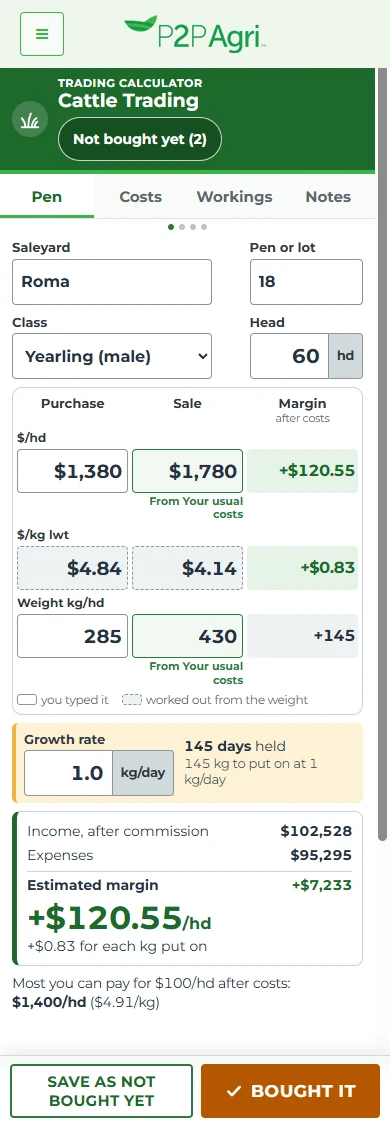
Three things make it different from a sum on the back of a catalogue.
- It starts from your own costs. You set up your levy, freight, health, agistment, feed, stock loss, interest and commission once, at the desk. Every pen starts from them, so the answer is yours and nothing is left out because you were in a hurry. If one lot is different, you change the cost for that pen only.
- It works with no signal. Saleyards are not known for good reception. Open the calculator once while you are in range and it keeps working at the yards. A pen saved with no signal is kept on the phone and sent when you are back in range.
- The pen does not stay in the calculator. Tap Bought it and the pen becomes part of your livestock figures, your livestock gross margin and your cash flow budget, with the purchase and the expected sale in the months they fall. A pen has to be paid for in one month and sold in another, and you can see what that does to the whole business. That gap is the difference between farm profit and cash flow.
There are other trading calculators in Australia, and some of them are good: state department spreadsheets, finance company web calculators and at least one phone app. What we could not find was one that carries the pen you bought at the saleyard straight into your whole-farm gross margin and cash flow. As far as we can tell, that makes this a first for Australia. If you know of another, tell us and we will correct this.
The full detail of how it works, including the feedlot version with prices in cents a kilo liveweight and a ration costed for each pen, is on the cattle trading and feedlot calculator page.
Record every pen you buy and track your profit per pen
A bid is a forecast. You only find out how good it was if you keep the pen on record and check it against what happened. In P2PAgri a bought pen keeps its purchase, its costs and its expected sale. When the cattle sell you record the date, the head, the weight and the price, in one lot or several, and the expected figures become actual ones.
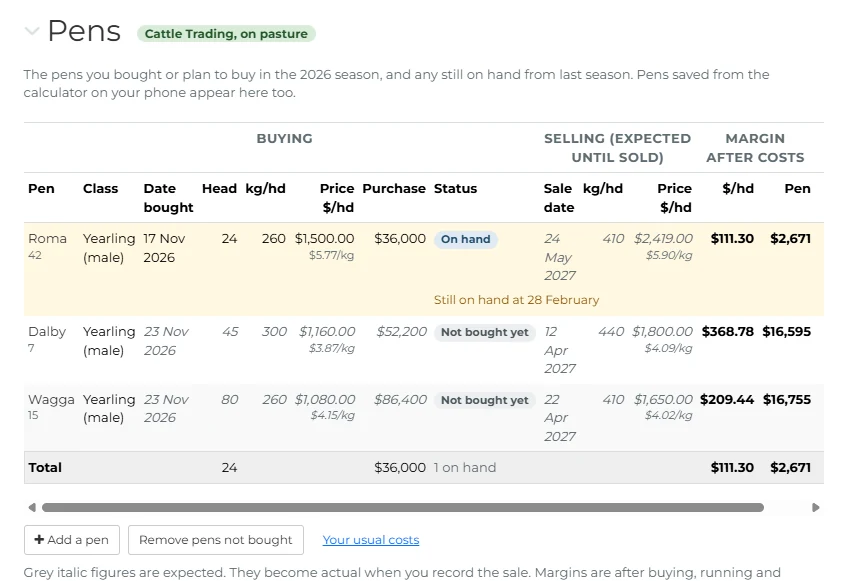
After a season of that, you can answer questions a bank statement cannot:
- Which pens made money, and which only looked as if they would?
- Do the cattle grow at the rate you budget on, or do they always take three weeks longer?
- Is the sale price you pencil in the one you get?
- Which class, weight range or saleyard has paid best on your country?
This is where confidence in trading comes from. It does not come from a feeling about the market. It comes from a top bid worked out from your own costs, and from a record that shows how your last twenty pens turned out. You bid knowing where to stop, and you stop without wondering what you missed. The record is also a useful page to hand your adviser or your bank manager when they ask how the trading cattle went, and it tells you your cost of production for a kilo of beef, pen by pen.
The short version
The most you can pay for trade cattle is the sale you expect, less every cost between the two sales, less the margin you want. Do the sum before the auctioneer reaches the pen, use your own costs, and include the grass and the interest. In the example, a pen that looked to have $540 a head in it had $171.56, and the top bid for a $100 margin was $4.43 a kilo.
If you do one thing before your next sale, write down what a steer costs you from the day it arrives to the day it leaves. That is the number the rest of the sum depends on.
Keep reading
Gross Margin by Paddock: Which Paddocks Actually Make You Money?
Gross margin by paddock shows which paddocks make money and which lose it. Work it out from header and input records and rate each paddock red, amber or green.
What Does Your Header Actually Cost Per Hour?
What does a header cost per hour in Australia? Machinery costs worked through in 2026 dollars: about $483 an hour at 500 engine hours, $1,565 at 100.
How to Benchmark Your Farm Business: The Numbers That Actually Matter
How to benchmark your farm business: six financial ratios that show whether your farm is getting stronger or weaker, and where to find improvements.