
Most farm business training follows the same pattern. You drive to a hall, spend a day working through a made-up case study, and go home with a folder that rarely gets opened again. The ideas might be sound, but they never quite connect to your own paddocks, your own debt and your own seasons.
Plan to Profit takes the opposite approach. Every exercise is done on your own business, inside P2PAgri, the farm business management platform that connects to Xero, MYOB and other accounting software. In 2026, Ag Innovation and Research Eyre Peninsula (AIR EP) brought the Plan to Profit Workshop Series to 19 Eyre Peninsula farm businesses, delivered entirely online. This is an honest look at how it went.
At a glance
- Course: Plan to Profit, run by AIR EP and delivered by P2PAgri
- Participants: 19 Eyre Peninsula farm businesses, July to September 2026
- Format: five fortnightly group sessions on Zoom, plus five private 1:1 coaching sessions
- Survey: 9 of 19 completed the post-course survey, a 47% response rate
- Result: 9 of 9 satisfied, 9 of 9 confident using financial information to make decisions
How the Plan to Profit course works
Plan to Profit was originally developed for Tocal Agricultural College in NSW, where it has run for five years and trained up to 100 farmers a year. The Eyre Peninsula course ran over ten weeks, from July to September 2026, in five steps:
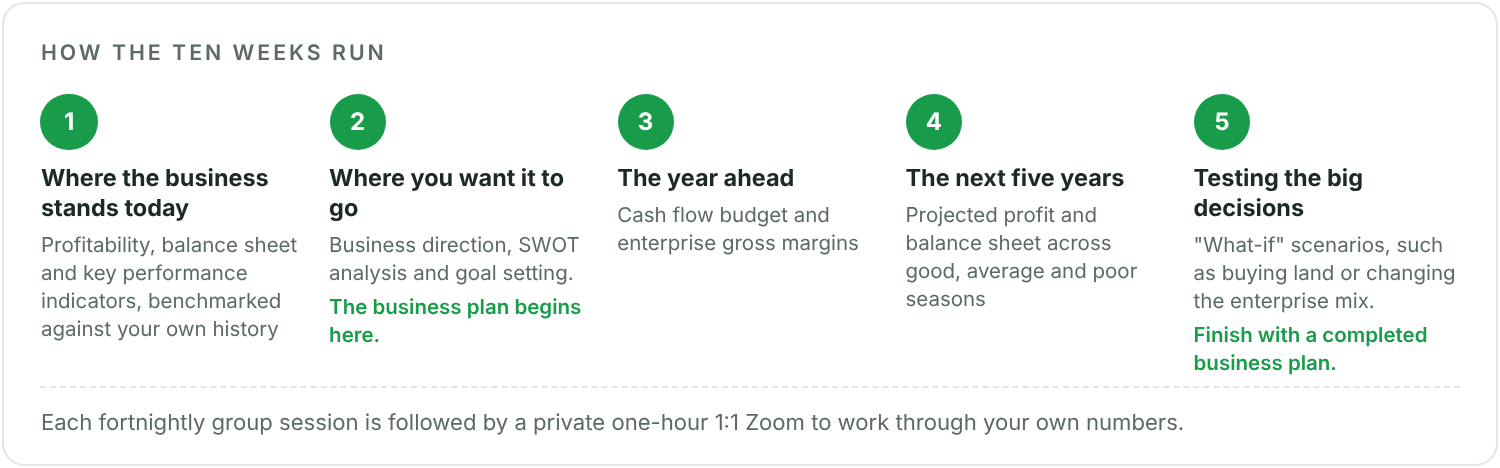
- Where the business stands today: profitability, balance sheet and key performance indicators, benchmarked against your own history.
- Where you want it to go: business direction, SWOT analysis and goal setting.
- The year ahead: a cash flow budget and enterprise gross margins.
- The next five years: projected profit and balance sheet across good, average and poor seasons.
- Testing the big decisions: “what-if” scenarios, such as buying land or changing the enterprise mix.
Each fortnightly group session runs for a morning on Zoom and is recorded. In between, every farmer has a private one-hour 1:1 Zoom with Mike Krause or a fellow P2PAgri adviser to work through their own numbers. Business figures are only ever discussed in those private sessions, never in front of the group. Allow about six hours a week. No advanced finance or computer skills are needed.
The 2026 Plan to Profit results
Of the 19 farm businesses that took part, nine completed the post-course survey, a 47% response rate. Because the group is small, we report actual counts rather than percentages alone.
- Satisfaction: all 9 were satisfied with the program, 8 of them very satisfied.
- Relevance and format: all 9 agreed the course was relevant to their farm business, and that the time commitment and Zoom format were appropriate.
- Confidence: all 9 are now confident using financial information to make farm business decisions. 8 of 9 are confident their business can identify and respond to financial risks such as drought or poor seasons.
- Action: every respondent had either started, or was planning, a written business plan, forecasts beyond the current season, and testing decisions with “what-if” scenarios. Five were already forecasting beyond the current season before the course finished.
- Staying power: all 9 said they are likely to keep using the tools, 6 of them very likely.
In their own words, participants described the most important change they are making:
“Putting less work into less profitable paddocks.”
“Running scenarios to assist with decision making and also the business plan…”
“I like how the whole farm enterprise is in one location.”
2026 Plan to Profit participants
What we will do better
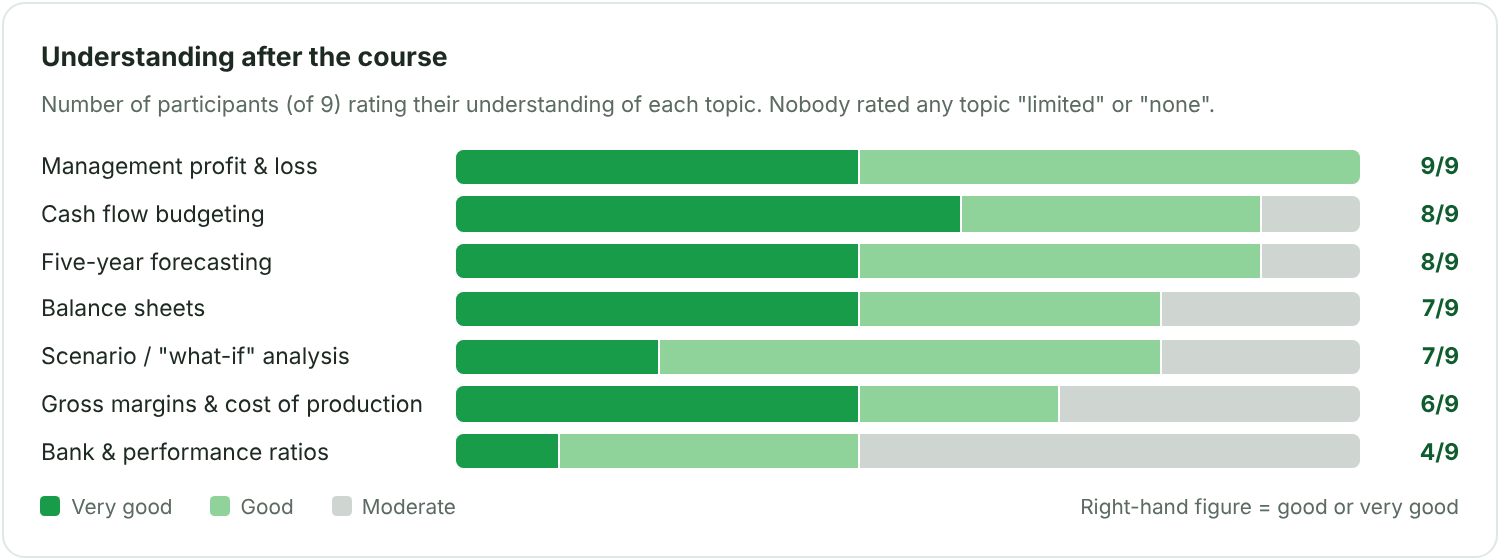
Bank and business performance ratios were the hardest topic: 4 of 9 rated their understanding as good or very good, and the other 5 as moderate. That topic will get more time and more worked examples.
Time was the most common barrier to putting changes in place (6 of 9). Participants asked for more time between sessions, shorter two-hour group sessions, running the course before seeding, and a 1:1 follow-up after harvest, which we are now looking at. No one named cost, complexity or lack of confidence as a barrier.
The 5 numbers every farm business plan should include
Whether or not you do the course, these are the figures the Plan to Profit farmers worked through. If you can answer each one for your own business, you are ahead of most.
1. Operating profit, not taxable income
Your tax return is built to minimise tax, not to show how the business is really performing. A management profit and loss statement strips out the tax adjustments so you can see what the farm actually earns year to year. Learn how to read your farm numbers.
2. Equity and return on assets
Your balance sheet shows what the business owns, what it owes and how that is changing. Return on assets tells you whether the capital tied up in land, machinery and livestock is working hard enough. These are also the first figures your bank looks at.
3. Peak cash need in the year ahead
A cash flow budget shows when money goes out and when it comes in, and how deep the overdraft gets before harvest or sale. Knowing that number before the season starts is far better than finding it out in August. See how P2PAgri handles farm financial management.
4. Gross margin by enterprise and paddock
Whole-farm profit can hide an enterprise or a paddock that loses money every year. Gross margins show which parts of the business are carrying the rest, which is exactly how one participant decided to put “less work into less profitable paddocks”. Our guide to gross margin by paddock shows how to work it out.
5. Profit across good, average and poor seasons
A single-year budget assumes an average season. A five-year plan tested against good, average and poor years shows whether the business can survive a run of droughts and still meet its goals, before you commit to buying land, expanding or handing over to the next generation. Explore scenario analysis.
Put those five together and you have something your accountant and your bank will take seriously. Here is how to get finance-ready.
Bring Plan to Profit to your region
The 2026 Eyre Peninsula course was an AIR EP project delivered by P2PAgri. Because it runs entirely on Zoom, the same format works for farmers anywhere in Australia, whether through a grower group, a regional body or as an individual business. Upcoming Tocal intakes in NSW are listed on our events page.
Register your interest for the next course, or ask about running one for your group: contact Mike Krause on 0408 967 122 or Mike@P2PAgri.com.au.
Download the full 2026 course report (PDF)
Frequently asked questions
What is the Plan to Profit course?
Plan to Profit is a farm business management course originally developed for Tocal Agricultural College in NSW. Over five fortnightly group sessions and five private 1:1 coaching sessions, farmers use their own figures in P2PAgri to review profitability, set goals, build a cash flow budget and finish with a five-year farm business plan.
Do I need to be good with computers or finance to do the course?
No. The course starts from the fundamentals and no advanced financial literacy or computer skills are needed. Questions are encouraged, and your own figures are only discussed in your private 1:1 sessions, never in front of the group.
How much time does Plan to Profit take?
Allow about six hours a week. Group sessions run for a morning on Zoom every fortnight and are recorded, so you can catch up if a breakdown or a sale gets in the way.
Can the course be run for farmers outside the Eyre Peninsula?
Yes. Because Plan to Profit runs entirely on Zoom, the same format works for farmers anywhere in Australia, whether through a grower group, a regional body or as an individual business. Contact Mike Krause to register your interest.
This is an AIR EP project delivered by P2PAgri that has been funded by the EP Drought Resilience Plan through the Australian Government's Future Drought Fund and Primary Industries and Regions SA, the RDA EP Small Business Fundamentals program and the GRDC RiskWi$e Initiative.
Keep reading
How WA Grower Lisa Jeitz Runs Six Farm Scenarios in a Day
Case study: Esperance grain grower Lisa Jeitz went from two weeks building farm budget scenarios in a spreadsheet to six in a day with P2PAgri and Xero.

Peter Aikman: A Farm Business Journey
Podcast: farmer Peter Aikman on improving his farm financial literacy with P2PAgri software, and the benefits of structured farm business management.

Farm Business Info: Easier & More Powerful
Podcast: Phil Dibben of Financial Services South Australia on how P2PAgri makes farm business information easier and more powerful for advisers and farmers.