
Most farmers approach the block next door with one question: can we afford the repayments. It is the right question to ask second. The first one is whether the land earns its keep at the price being asked, and whether leasing would get you the same production for less capital. Those are different questions with different answers, and Australian farmers have almost nothing local to work from when they try to answer them.
Quick Answer
Leasing and buying answer two different questions.
- Leasing wins on return per dollar of capital. You buy the production without buying the asset. At equal scale the detailed Australian modelling puts leasing at a 9.9 per cent internal rate of return against 6.6 per cent for buying. But deploy the same capital either way and the two are line ball, 6.4 against 6.6 per cent. Leasing frees capital rather than earning a higher rate on it.
- Buying generally wins on wealth, if land keeps rising. The most detailed Australian analysis found buying beat leasing only where capital growth held above roughly 5.4 to 6.8 per cent a year.
- That assumption is the whole decision. Australian farmland has compounded at 7.2 per cent over 20 years and 12.2 per cent over the last five. Rabobank forecasts about 2 per cent for 2026. Which number you build on decides the answer before you start.
The honest framing: are you buying an operating business, or are you buying a bet on land prices with an operating business attached?
Start with what farmland actually returns
ABARES publishes the number almost nobody quotes. Once capital appreciation is excluded, it reports that around half of broadacre farms would have earned a negative rate of return. Not a thin return. A negative one.
Now put that beside the return including capital appreciation. Averaged over 2021-22 to 2023-24, the largest 10 per cent of broadacre farms returned 12.3 per cent and the smallest 10 per cent returned 1.6 per cent.
The gap between those two measures is the most important thing on this page, and both come from the same ABARES series over the same period, so the comparison is like for like. A large share of the return to owning Australian farmland has come from the land revaluing rather than from farming it, and for the smaller half of farms it is more than all of it. Dairy tells the same story more gently: a 2.4 per cent average return over the decade to 2018-19 excluding capital appreciation, 2.9 per cent including it.
One definition matters before you use those figures anywhere else. The ABARES rate of return is farm business profit plus rent, interest and finance lease payments, expressed as a percentage of total opening capital. It is an unlevered return on all the assets at market value. It is not the return on your own equity, and it is not what lands in your pocket after the bank has been paid.
That is not an argument against owning land. It is an argument for being honest about what you are buying. If the operating return is under 1 per cent and the borrowing cost is near 8, the purchase does not stack up on farming alone. It stacks up on capital growth, and capital growth is a forecast, not a fact.
And land price follows profit, not the other way around
Research published in Applied Economics in 2025 by Associate Professor Amir Arjomandi at the University of Wollongong, writing with lead author Hassan Gholipour and colleagues, traced Australian broadacre farmland from about $1,165 per hectare in 1992 to about $9,400 in 2023, a more than eight-fold rise, with the sharpest surge between 2020 and 2022. The finding that matters for a buyer: when farm profits rise, land prices follow with a lag of two to five years. Higher land values then push up production costs through rates, insurance and the cost of borrowing to expand, which erodes profit again.
In other words, price is a lagging function of profit that has already been earned. Buying at the top of a price cycle means paying for a run of good years that is behind you.
What the land is worth, and where it is heading
Bendigo Bank Agribusiness put the national median at $10,516 per hectare for calendar 2025, up 2.8 per cent, the slowest growth in a twelve-year unbroken run. Transaction volumes ran 15.6 per cent below the ten-year average.
| State | Median $/ha | Change in 2025 |
|---|---|---|
| Tasmania | $18,424 | -20.6% |
| Victoria | $14,790 | -0.4% |
| Queensland | $10,439 | +5.8% |
| New South Wales | $9,884 | +4.5% |
| South Australia | $9,421 | +20.4% |
| Western Australia | $7,255 | +6.7% |
Bendigo Bank Agribusiness, Australian Farmland Values 2026, published 5 May 2026, reporting calendar year 2025. Medians, per hectare, nominal. Tasmania is a thin market, while South Australia’s rise is attributed to lifestyle sales and smaller parcels. Both extremes reflect composition and volume effects rather than a revaluation of productive country.
The growth rate you assume decides the outcome, so it is worth setting out the choices honestly. The national median has compounded at 7.2 per cent over 20 years and 12.2 per cent over the last five. ABARES, using a different method, has broadacre farmland averaging 9.8 per cent a year over ten years. Rabobank is forecasting about 2 per cent for 2026 and similarly moderate growth through to 2031. Bendigo’s own outlook points at further rate rises, a dry seasonal outlook and rising costs weighing on sentiment, and its analysts have said the era of speculative property appreciation is over.
Build your model on the last five years and buying wins comfortably. Build it on the last twenty and it is close. Build it on what two independent forecasters are currently projecting and it does not clear the cost of debt.
What leasing actually costs
The rules of thumb here have quietly stopped working, and a lot of negotiations are still being anchored to them.
The traditional guide, still published by the NSW Young Farmer Business Program, is that lease values sit between 5 and 9 per cent of land value for grazing and dryland cropping, and around 10 per cent for irrigated country. Apply 5 per cent to the current national median and you get $526 per hectare. Apply 9 per cent and you get $946. Very little low rainfall country clears at those levels, although as the South Australian table below shows, good Yorke Peninsula land still does. The rule has not stopped working everywhere. It has stopped working where land values have run away from what the country produces. Note too that the national median covers every farmland sale including lifestyle blocks, so applying it to a grazing or dryland cropping lease flatters the result.
ORM said as much back in 2021: the old guide of rents at 4 to 5 per cent of land price is “difficult to support where land values have increased so rapidly”. ORM found implied yields on recent Western Victorian sales below 2 per cent, and recommended abandoning the percentage-of-value method altogether in favour of a production split, allocating the lessor roughly half of crop net income after input expenses and machinery operating costs.
What land is actually leasing for
The most current Australian reporting is from South Australian agents in January 2026.
| Region | Quoted rate | Per hectare |
|---|---|---|
| Yorke Peninsula, premium | Over $400/ac | About $988 |
| Yorke Peninsula | $180 to $250/ac | $445 to $618 |
| Mid North | $100 to $175/ac | $247 to $432 |
| Eyre Peninsula, premium cropping | $120 to $150/ac | $296 to $371 |
| Eyre Peninsula, marginal grazing | About $30/ac | About $74 |
| Riverland and Mallee | $20 to $25/ac | $49 to $62 |
Agent commentary reported in Stock Journal, 21 January 2026. GST treatment is not stated for any of these figures. A twenty-fold spread inside one state is the reason no national average is worth quoting.
Price the lease off production instead
Every durable Australian method starts from what the country produces rather than what it sold for. RIRDC, now AgriFutures Australia, in its 2011 land leasing guide, recommended triangulating three ways: a rate of return on land value, a rate per unit of production such as dollars per DSE, and a percentage of expected gross margin. Its own words: all of these methods need to be considered when assessing a fair lease price. The dollar figures in that guide are fifteen years old and unusable. The method is not.
For a percentage of gross margin, NSW DPI has used 25 per cent for cropping and GRDC has used 30 per cent, which on a $30 per DSE sheep gross margin works out at about $9 per DSE a year. On a rate per unit of production, the RIRDC guide put the range at $10 to $20 per DSE a year. Be careful with the $1 per DSE per week figure that circulates: it is published as a long term agistment rate, and at $52 per DSE a year it is several times any of the lease benchmarks above.
How much difference does the method make? The same NSW Government factsheet works both methods through and gets $240 per hectare from the percentage-of-value method on land valued at $4,000 per hectare, against $135 per hectare from the production method on a 500 hectare mixed enterprise. They are two different examples rather than one property costed twice, and the factsheet describes the gap in its own words as a lease payment “approximately 40% less”, or about 44 per cent lower. Either way it is a wide spread between two methods inside one document. If you are negotiating a lease and the other party is anchored on the first method while you are anchored on the second, you are not disagreeing about the country. You are disagreeing about arithmetic.
Whichever way you go, the number has to come out of a gross margin. Our crop gross margin tools exist to produce exactly that figure for your own paddocks rather than a district average.
The costs only an owner carries
Comparing rent against loan repayments understates the cost of buying, often badly. Here is what sits outside the repayment.
Stamp duty, paid on day one
On the NSW 2026-27 scale, a $2 million farm attracts $91,287 of transfer duty. At the NSW median of $9,884 per hectare, that is roughly nine hectares of country handed to the state before you have turned a wheel. In Queensland the same purchase is about $95,525.
Family farm stamp duty exemptions exist in NSW, Victoria, Queensland, Western Australia and South Australia, and they are routinely misunderstood. They apply to intergenerational transfers between relatives. They do not apply to an arm’s length purchase of the block next door.
Council rates, every year, in every season
Victorian councils setting 2026-27 farm rates landed on rates in the dollar between roughly 0.0015 and 0.0031 of capital improved value, which is about 0.15 to 0.31 per cent of value a year. On a $2 million holding that is roughly $3,000 to $6,200 annually, payable in drought years as well as good ones. Most councils apply a farm differential of 40 to 80 per cent of the general rate, which is a discount plenty of farmers do not realise they are receiving.
Land tax, which is conditional and not automatic
Every state that levies land tax exempts genuine primary production land, but the exemption has to be earned and held. In NSW it turns on a dominant use test assessed on area, scale, intensity, financial significance and duration, plus zoning, plus a commerciality test for land that is not rural zoned. It applies to whole parcels only. Change the dominant use and you lose it. A lessee never carries this exposure at all.
And GST works the opposite way to what you expect
The sale of farmland is GST-free where it has been used in a farming business for at least the five years immediately before sale and the buyer intends to keep farming it. A lease is only GST-free if it runs 50 years or more, or comes from a government agency. An ordinary three to five year farm lease is a taxable supply, so GST applies to every rent payment. If you are registered you get it back, but not until the BAS.
So the buyer usually pays no GST on a multi-million dollar asset while the lessee pays it on every instalment. Worth building into the cash flow, and worth confirming whether any quoted lease rate is inclusive or not.
Comparing the two on the same basis
The most complete Australian analysis of this question is a discounted cash flow published by Agrista in December 2020. It modelled a 10,000 DSE grazing business expanding by 2,500 DSE, either by purchase or by lease, over ten years, measured on the discounted cumulative cash position including capital gain.
| Scenario | Purchase | Lease | Breakeven capital gain |
|---|---|---|---|
| Same scale of expansion | NPV $730,543, IRR 6.6% | NPV $327,075, IRR 9.9% | 5.4% |
| Same capital invested | NPV $730,543, IRR 6.6%, 2,500 DSE | NPV $687,043, IRR 6.4%, 13,782 DSE | 6.8% |
Agrista, John Francis, December 2020. Note the weighted average cost of capital used was 4 per cent, which is well below current borrowing costs. Rerun at today’s rates and the purchase case weakens.
Look at scenario one closely, because it contains the whole argument. Leasing produces the higher internal rate of return, 9.9 per cent against 6.6, and the lower net present value. Leasing is the better return on the capital you employ. Buying is the better absolute wealth outcome, and only if the capital gain assumption holds.
Then look at scenario two. For the same money, the leasing business ran 13,782 DSE against 2,500. That is the real trade: five and a half times the production, or the title.
The genuinely useful output of that model is not the NPVs, which are six years old and built on a 4 per cent cost of capital. It is the breakeven capital gain: buying wins if land keeps compounding above roughly 5.4 to 6.8 per cent. Against the 20-year rate of 7.2 per cent it just clears. Against Rabobank’s 2026 forecast of about 2 per cent, it does not.
A quick test you can do on the back of an envelope
American extension services use a measure worth borrowing, though the figures behind it do not transfer. It is called the cash rent equivalent: take the annual interest on the land purchase, not the principal and interest, add the rates and insurance, and divide by the hectares you would own. That gives you what the land costs you per hectare per year to hold it. Principal is not a cost, it is a transfer into your own equity, and including it overstates the cost of owning.
Then compare it with what the same country leases for locally. If your cash rent equivalent is well above the local lease rate, you are paying a premium for the title, and the size of that premium is the price of your capital growth bet. It is rough. A fuller comparison would also put an opportunity cost on the deposit you tie up, and amortise the stamp duty over how long you actually expect to hold. But it takes five minutes and it reframes the conversation.
What the money costs right now
The RBA held the cash rate at 4.35 per cent on 11 August 2026, after three increases in the first half of the year. The Board said inflation “is still too high”, is not expected back at the midpoint of the target band until late 2027, and that it would continue to do what is necessary “including increasing the cash rate target further if upside risks materialise”.
The Regional Investment Corporation lifted its variable rate to 5.71 per cent on 1 August 2026, its first increase in two years. RIC states that its rate sits about two percentage points below comparable commercial lending, worth roughly $20,000 a year on a $1 million loan, which implies commercial agribusiness rates in the high sevens.
No Australian bank publishes agribusiness term loan rates and no industry body compiles them, so treat any published average with suspicion, including that inference. Get a written indicative rate from your own lender. On gearing, expect to be advanced 60 to 70 per cent of value on commercial rural property, which means a 30 to 40 per cent deposit or other security.
The context that matters: a buyer today is taking on debt at the top of a tightening cycle, from a central bank explicitly refusing to rule out further rises. That is a different risk profile from the 2020 and 2021 purchases that set current price expectations. Our article on farm debt and healthy borrowing works through where the limits sit.
The risk each option puts on you
A lease and a mortgage are both fixed commitments that fall due in a poor season. The differences are more subtle than the pitch on either side suggests.
A lease ends. Three to five years is the normal term. If the country does not perform, or your circumstances change, you hand it back. A mortgage does not end when the season does.
A lease does not gear your balance sheet. Buying pledges the whole business against one asset and reduces your equity ratio, which changes what your bank will do for you next time. Leasing leaves borrowing capacity intact for machinery, working capital or a better opportunity.
A lease has no upside. If land doubles, the lessee has nothing to show for it. That is exactly what buyers are paying for, and it is a real thing to want.
Neither is forgiving in a dry year. As one Australian leasing guide puts it plainly, the landowner will still expect lease payments in a dry season. Some leases are CPI-indexed or partly linked to rainfall. Negotiate that at the start, because you will not renegotiate it in the middle of a drought.
Whichever way you lean, model the poor year first. Running the same expansion across a poor, average and good season is exactly what scenario analysis is for, and it is the difference between a decision and a hope.
Where the lines should sit
If you do go to buy, our earlier piece on whether you can afford to buy the neighbouring block sets out the thresholds. They are worth restating here because they apply just as well to deciding you should lease instead.
| Measure | Comfortable | Caution | Danger |
|---|---|---|---|
| Debt servicing as a share of income | Under 20 to 25% | 25 to 30% | Over 30% |
| Equity ratio | Over 80% | 60 to 80% | Under 60% |
| Return on the land against cost of capital | Over 5.5% | 3 to 5.5% | Under 3% |
Test the first line in a poor year, not an average one. A purchase that sits at 18 per cent debt servicing in a normal season can be at 26 per cent in a bad one, and the bad one is the season that decides whether the decision was sound.
When leasing is the better answer anyway
Even with the cash to buy, leasing often wins:
- When scale is the constraint, not ownership. If the machinery and labour you already own are underemployed, leasing spreads those fixed costs across more hectares immediately. That is usually the single largest and most certain gain in any expansion.
- When you want to test the country first. Three years of farming a block teaches you things no due diligence will.
- When the next decision needs the capital. Succession, a machinery replacement, or a genuinely better block that appears in two years.
- When the price implies a growth rate you do not believe. If the sums only work at 10 per cent capital growth, you are not buying farmland. You are taking a leveraged position on farmland prices.
- When the alternative use of the money is better. Our comparison of expanding on farm against investing off farm works that version of the question.
Before you sign either one
If you are leasing, the NSW Young Farmer Business Program publishes a free leasing and agistment toolkit including a sample lease agreement, a checklist and a lease calculator. Two things in that material are worth flagging. The sample lease says in one clause that the lessor pays rates, then hands council rates, Local Land Services rates and water charges back to the lessee in the outgoings schedule. Whether rates land on you is decided in the schedule, not the headline clause. And fences, weeds and vermin are all pegged to their condition at commencement, which is unenforceable in both directions unless you do a joint inspection with a written condition report and photographs before you sign.
One item no Australian lease template solves: residual fertility. If you lime and build phosphorus in year one of a three-year lease, nothing in the standard documents compensates you for what you leave behind. It is the largest unaddressed value transfer in Australian farm leasing, and the main reason short leases produce soil mining. Negotiate it, or negotiate a longer term.
If you are buying, the rural due diligence that matters most is water, access and zoning. Confirm that water access licences transfer with the land and that stock and domestic rights are separate from irrigation entitlement, because owning the land does not automatically give you the right to use the water on it. Confirm legal access to a public road or a registered easement on title, and never rely on an informal arrangement with a neighbour. Check the LEP for zoning, dwelling entitlement and minimum lot size.
One more thing for anyone buying now with an eye on eventually selling: the 50 per cent capital gains tax discount is being replaced by cost base indexation, with a 30 per cent minimum rate on net capital gains. This one is law rather than a proposal: the Treasury Laws Amendment (Tax Reform No. 1) Act 2026 received Royal Assent on 26 June 2026, and the change applies to gains accruing from 1 July 2027. It is prospective, so growth accrued before that date keeps the 50 per cent discount and only growth after it is indexed, which means country bought today will have split treatment on an eventual sale. It changes the after-tax value of the capital growth the whole buy case rests on, so raise it with your accountant before you commit, not after. Ask about the small business CGT concessions in the same conversation, because for a retiring farmer they often matter more than the discount does.
The decision in one page
- Work out the gross margin the country produces in a poor, average and good year. Everything starts there.
- Price the lease off production, not off land value. The old percentage rules no longer reconcile with either market.
- For the purchase, add stamp duty, rates, insurance and due diligence to the repayments, then divide by hectares to get your cash rent equivalent.
- Compare that with the local lease rate. The gap is what you are paying for the title.
- Ask what capital growth rate the purchase needs to beat leasing, then ask whether you actually believe it.
- Test both against a poor season, and check debt servicing and equity against the thresholds above.
P2PAgri is built to run exactly this comparison across five years, with your own gross margins, your own debt and your own seasons. Scenario analysis and cash flow planning are where the two options stop being an argument and start being two sets of numbers.
There is no universal answer here, and anyone offering one is selling something. What there is, is a question the numbers can actually settle: at this price, on this country, in this season, does the land earn its keep, and would the same money buy more production leased than owned. Work that out first. The financing conversation is much easier afterwards.
Keep reading
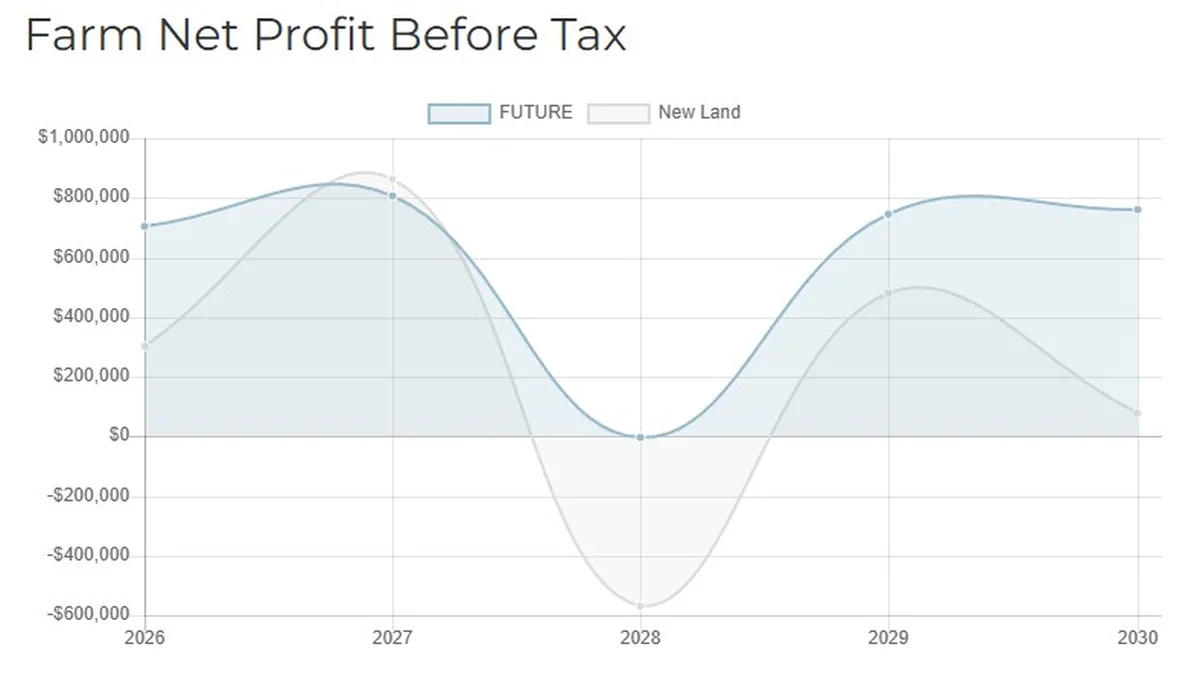
Should You Buy That Farm Next Door? A Financial Framework for Land Purchase Decisions
Should you buy the farm next door? A financial framework for land purchase decisions: five questions to answer before signing, and how to model the numbers.
Post-Harvest Farm Business Review: 10 Numbers to Check Before the Bank
A post-harvest farm business review in 10 numbers: yield, price and cost variances, cost of production, grain on hand, cash low point and your bank ratios.
Agrimaster Alternatives for Australian Farms (2026)
Agrimaster alternatives for Australian farms in 2026: P2PAgri, Figured, Phoenix and Xero compared on price, cloud access and farm planning depth.