
Know Your Numbers: Inside the Farm Office of a 6,500ha Esperance Cropper
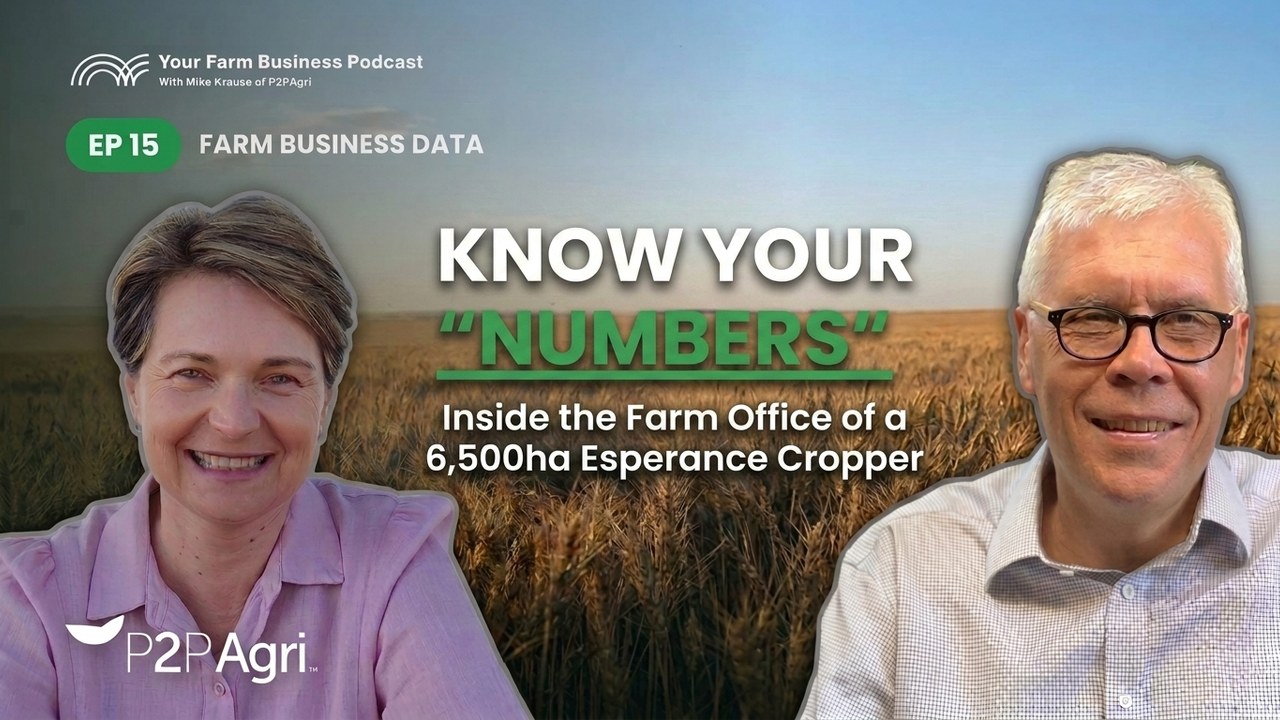
Podcast transcript from Your Farm Business Podcast
How does a 6,500 hectare cropping business keep its numbers sharp enough to make big decisions with confidence? In this episode of Your Farm Business Podcast, P2PAgri founder and CEO Mike Krause steps inside the farm office of Lisa Jeitz, who farms with her husband Kirk at Cascade, near Esperance in Western Australia.
Lisa is a farmer's daughter, a trained agronomist and a former farm business management consultant, and she runs one of the most disciplined farm offices you will find: cash flow budgeting first, gross margins checked against actuals, more than 20 years of records with no gaps, grain price targets that lock in profit rather than break even, and a hard ceiling on machinery spending. This is what farm business data looks like when it drives real decisions.
From Farm Consultant to Esperance Farmer
Mike Krause:
I'd like to welcome Lisa Jeitz to the podcast, and it really excites me to talk with her, because she is someone who has put together really good farm business management practices in her own farming business at Esperance. She also comes with a background of working early in her career as a farm business management consultant for an accounting firm in WA. Lisa, welcome.
Lisa Jeitz:
Thanks, Mike. I'm a farmer's daughter and I studied ag science at UWA. My first job was in Esperance as a nutrition and disease agronomist, working with an independent group of farmers for three years. Then I moved to the accounting firm to do business management consulting, which is really where I fell in love with numbers, budgeting and the economics of farming. I did that for ten or twelve years before I moved to the farm with Kirk, and when we started having a family I stepped into the office.
Mike Krause:
So you saw a number of different farm businesses in that part of your career, and that didn't put you off becoming a farmer.
Lisa Jeitz:
Quite the opposite, I found it super inspiring. Esperance is a place of great opportunity, and everybody from Esperance is new because it's such a new farming region. The enthusiasm, creativity and willingness to try new things was absolutely inspiring.
Wall-to-Wall Cropping at Esperance
Lisa Jeitz:
We're a cropping operation, which is super common; there are probably more all-croppers than mixed crop and livestock businesses in Esperance nowadays. We've got six and a half thousand hectares of crop, which is actually medium size in Esperance. Around two thousand hectares is a standard block, and there are a great number of properties at 20, 30, 40, 60,000 hectares plus. We're not the largest by any means, but we are 100 per cent crop and have been since about 2000, when my husband and his family decided to let go of the sheep. We would say we are high performance croppers: we're looking for yield, with pretty high inputs.
We're known for being extremely reliable on rainfall, and we get a reasonably high percentage of summer rain, so managing soil moisture over summer with summer spraying is super important. As the district has managed that and kept the green bridge dead over summer, yields have risen and disease burdens have lowered.
Cash Flow Comes First: Budgeting as a Company Director
Mike Krause:
Switching to budgeting and how you run the farm office: what are the important budgets you use to manage the business?
Lisa Jeitz:
I personally find cash flow budgeting the most important, because we run as a company structure. It is actually the law that the directors need to ensure we're solvent, which means we have the funds available to pay our bills as they come due throughout the year. So cash flow is my top priority, and I monitor it on a regular basis. Fortnightly would ideally be when I do a budget update once I've reconciled, but there is a lot to do in the office, so I definitely reconcile monthly. At the very minimum I do financial reporting back to the stakeholders in the business every second month, so they can see visually, in a printed report, where we're at. I print out all their favourite reports, the things my husband and parents-in-law ask me about regularly, so I feel like I'm getting ahead of them a little and providing the information before they ask.
Mike Krause:
So that's a core two-monthly meeting at home with the major stakeholders around the table, reporting cash flow planned to actual. Do you bring any other budgets into that, or are gross margins and profit and loss more of an annual exercise?
Lisa Jeitz:
On an annual basis I do a really thorough suite of gross margins for each crop type. We're lucky, it's simple: we do wheat and canola, and for a long time it's been 50-50. As soon as you bring livestock in, gross margins get much more complicated, so I appreciate that I have it relatively easy in that department.
Gross Margins: Planned vs Actual, and 20 Years of Records
Mike Krause:
A lot of farmers might do gross margins for planning. Do you actually turn around and do actuals at the end of the season?
Lisa Jeitz:
Definitely. It's super important to do the actuals, otherwise I don't know if my gross margin figures are any good. How do we make a good decision next year if last year's planned gross margin was absolutely rubbish? I also keep a long-term spreadsheet, like your consultant might: the price I get for every crop for every year, tracked for 20-plus years, the yield across time, and the costs in dollars per hectare of every input on the budget line. When I'm doing a budget and gross margins, I like to use somewhere between a five and ten year average cost per hectare for all of my budgeted lines, the crop inputs as well as the overheads.
Subjective memory would say I spent almost nothing on most things and everything was really cheap. We know that's not true; I need the facts. Sometimes it's more important to use recent costs. Insurance has gone up so much that I use closer to a five year average there. At least I've got a really good basis, and I can say why I chose a cost for a particular line. It also keeps it real for us. Kirk can say, Lisa, you're spending too much on wages in that area. Or I can say, Kirk, you thought repairs would be down because of all the new equipment, but they've actually gone up 20 per cent year on year. What's going on?
Pricing Crop Two Years Ahead
Mike Krause:
During the year, one of the challenges is commodity price fluctuation. I suspect you do a mixture of forward selling, selling at harvest and selling post-harvest, so you're keeping a close eye on all of that.
Lisa Jeitz:
Inputs are our biggest expense, and they fluctuate enormously. Wherever possible we price them as early as we can, lock them in and order them, to put a fixed price in the budget. Then we've got something to work with when we're pricing our crop. I always like to have some crop priced two years in advance, whether that's a cash contract or a futures contract. I put targets in place, $400 plus for wheat and $800 plus for GM canola, and have those sitting with my grain marketer as far out in the future as possible, so if a one-off opportunity comes up they can grab it and I don't miss it. That gets a run on the board, gives us a starting point, and we feel confident we've got that first handhold on the ladder.
A Price That Locks In Profit, Not Break Even
Mike Krause:
You pulled out $800 for canola and $400 for wheat. Is that based on a cost of production assessment, or on historical records?
Lisa Jeitz:
I know we make a profit at those two prices with our crops and our operating system. Even two years in advance, when I haven't done that season's cost planning yet, I can lock in that price and not feel any discomfort. It helps me sleep at night.
Mike Krause:
That's quite unique. Cost of production usually looks at where profit is zero, and you don't really want to aim there, because you'll end up with zero at the end of the year. We should be aiming for a price that puts us in a profitable position, so we know we've got a viable business.
Lisa Jeitz:
A true technical gross margin allows a consultant, agronomist or economist to compare different businesses with each other. I understand that, and when I did it professionally, that's what I would do. But for myself, I'm not comparing with other growers, I'm assessing my own needs. So on top of all the variable costs for the crop, I actually cost in my overheads, my drawings, wages, machinery payments, tax and profit. There might be a better word for it, but I still call it a gross margin. I'm setting a price that includes a profit for me, and that's important for decision making.
The 10 Per Cent Machinery Rule
Mike Krause:
So that's one of your KPIs. Are there a couple of other KPIs you watch, apart from what's happening in the overdraft?
Lisa Jeitz:
I want to be in the black overall. And we spend a lot on machinery. We like a new, modern fleet, we like the latest technology, and we're early on the uptake of new technology. We like shiny new things, so it's very tempting to spend too much. So I monitor closely that our machinery finance is less than 10 per cent of our gross farm income. That's a personal, year-in-year-out KPI and it works for our business. We don't buy new gear if we can't keep it under that lid, or we have to sell something to stay under it. And when we are buying new technology, we need to know it can pay for itself over a one to five year period, or it has to fit inside that ten per cent.
Optimal Timing: The Key Driver of Success
Mike Krause:
There are two different principles I see farmers adopt. One says we'll buy second hand and look after it. Others, like you, buy new for the latest technology and the efficiencies that come with it. And one of those, I guess, is timing.
Lisa Jeitz:
Kirk has an amazing gut feel for the timing of operations, and optimal timing is probably the one key driver of our success. A lot of our machinery decisions and operational decisions are based around optimising the timing of whatever that application might be. It's a big topic of conversation, thought and energy in our process.
Mike Krause:
That leads me to something else. Would water use efficiency be a KPI in your case?
Lisa Jeitz:
I look at it as something you consultants keep track of. We have very wet years and very dry years, and our yield is actually very stable and growing year on year, so it doesn't give us much information. On a dry year our water use efficiency is unbelievable, and on a really wet year it doesn't get any better. We can have wet droughts: if it's too wet, we'll actually reduce our yield. So it doesn't track that well in our situation.
I don't think there's any ground in Esperance that could tolerate deep ripping where it hasn't been done, it's that popular. It allows for really great drainage, it gives the roots a bigger bucket to draw from in a dry year, and it gives more oxygen in a wet year. Cutting through the compaction layer is where it's been most effective.
A Farmer's Balance Sheet, Not an Accountant's P&L
Mike Krause:
Coming back to budgeting: some of us tend to be driven by tax compliance. We do the tax return every year and rely on the balance sheet and profit and loss in it. But really we should turn those into a management profit and loss and a management balance sheet. Is that something you do annually when you review how the business is going?
Lisa Jeitz:
I look at a statement of position way more than I would ever look at a profit and loss. I don't bother producing a profit and loss out of my software at all. I consider that an accountant's tool, not a farmer's tool. I like to look at growth in the business not including land price growth, because that helps me measure what our operation actually generated.
Mike Krause:
Rather than riding on the back of increasing land values.
Lisa Jeitz:
You do need to increase the land values over time, because otherwise the balance sheet flatlines for a while and then has a big jump up. So I've almost got two running: one where I put what we consider a realistic land price increase in every year, and another with no land price increases in it at all.
Mike Krause:
So you run a pure ruler over your management ability rather than what's happening with land values. Is equity something you look at, Lisa?
Lisa Jeitz:
That's important. It's very difficult with land expansion at the moment, especially in Esperance, where around 1,100 hectares would be a small block. To add that chunk on at current prices is a very big number. To expand, you're going to have to go below 70 per cent equity into the 60s. That's pretty painful, but I might need to reset my mindset if we're going to expand. I might have to wear that for a while and go through the pain.
Five Year Budgets and the Expansion Question
Mike Krause:
What budgets would you do if you were considering expansion?
Lisa Jeitz:
I'll do a looser five year budget, and I do use P2P because it's really great at rolling that out quickly. It doesn't take much time to prepare a five year rolling budget going forward. I also like the traditional year-in, year-out budget, a style of calculation that's been around for thirty or forty years. It's relatively easy to do, and it lets you take a far-out look at what the operation might look like once you've paid down some debt and some machinery, past that initial growth phase. Are you going to be profitable once the initial hump has passed? It uses well-founded assumptions that have been around a long time, so you don't need to get too wound up in the detail.
Mike Krause:
Do you look at return on assets managed, or is it more about future generations and wanting a bigger farm to pass on?
Lisa Jeitz:
If you stay the same size and time goes on, you're actually going backwards. That's a strongly held, philosophical point of view, I guess: you need to be moving forward, even if it's in a small way, otherwise growth in the economy will take you over, and your business will diminish. There does need to be forward growth.
Their "Why": More Profit From the Same Land
Mike Krause:
If we start with the end in mind, the end in mind is really: why are we farming? What's our vision, what's our mission?
Lisa Jeitz:
Kirk's parents have retired, and they still love to see what we're doing on the farm and are involved every week, but Kirk and I are the drivers. Our kids are in their late teens, and our two children are very keen to come back to the farm in time, but they're still very young, so they're not able to share the risk with us yet. At the moment it's very much about providing Kirk and me with personal and professional satisfaction. Expansion isn't our main priority. We're just trying to farm the best we can, push ourselves technically, try new things, and we get great satisfaction out of that on a daily basis. We're actually trying to get more profit out of the area we've got at the moment, rather than expanding. And unfortunately Kirk and I are perfectionists, so we like to do everything we put our hand to really well.
Mike Krause:
I think that's a great strategy, and something other farmers can take on. I do see farmers wanting to expand before they've really got the management sharp on their own business. The best way of earning more income is using the assets you have better, rather than expanding your assets when you're not managing them as well as you could.
Lisa Jeitz:
It might be the same in other regions, of course, but land here is really hard to come by and highly competitive. Land moves quickly, prior to going onto the market, and it's difficult to secure if you did want to expand. So people are moving very far away and splitting their operations. That would work really well for some people, but Kirk and I have looked at it many times and it just wouldn't work for us, because we value optimal timing so much. Having to travel so far, running two sets of smaller, less ideal equipment, or relying on staff further afield wouldn't suit our management style. It might be holding us back, but we're waiting for the opportunity to get something close, and hopefully we'll be ready when that occurs.
The Next Generation: Not Home Before 25
Mike Krause:
You did mention the kids coming home.
Lisa Jeitz:
Are they definitely coming home, or are we giving them enough wings to fly around the economy and work out whether that's what they really want to do? We'd really prefer they don't come home till after they're twenty-five. Actually, we've told them they can't come home till after they're twenty-five. We'd really like them to get some kind of qualification that interests them and work for other people, so they see what other types of businesses are like, work in big and small business, have different bosses, and learn different ways of being managed and of managing people. These are things we would have liked to have learnt more about ourselves.
Mike Krause:
It's always hard with the next generation, because you need to work out what their desires and skills are, rather than forcing them into the business for the rest of their lives.
Lisa Jeitz:
We really understand they may not like it, and there's plenty of room for that.
Hindsight, and Advice for the Farm Office
Mike Krause:
Final question. Put yourself on the sandhill ten years ago, with all the financial systems you've now got in place for planning and reporting. Is there anything you're doing now that you feel you should have been doing ten years ago?
Lisa Jeitz:
Maybe expand a bit quicker and take more risk earlier, because land prices went up an extraordinarily steep slope that we didn't anticipate. We thought we had plenty of time to grow and consolidate, grow and consolidate. That's hindsight, and I can never get that one back. I don't regret any of the decisions I've made, but if I had the crystal ball, that one would have been good.
Mike Krause:
What about in your farm office?
Lisa Jeitz:
I've picked up techniques for strategy and time management recently, and I think I would have done much better had I had those earlier. But technically, with budgeting, gross margins and assessing the numbers, I've spent a lot of time on that and I do not regret it. I probably did more earlier because I didn't have any gut feel to go with, so I used the numbers to develop my instincts. Now I can do it less frequently and sleep well at night, because I've developed a really good grounding and understanding. If you're early in your journey in the office, don't skimp on doing the numbers thoroughly and keeping the records. I've got a really great spreadsheet of yield over time and costs over time, and there are no gaps in it. I've worked hard to make sure it was completed every year, so I've got a really good bank of information to go back on. I'd never regret that.
"Charlie from Clarkson's Farm"
Mike Krause:
So the golden nugget in the toolbox is knowing your numbers, and having confidence that the numbers you're using are correct.
Lisa Jeitz:
Kirk started calling me Charlie from Clarkson's Farm, because I can be painfully annoying. But it does allow for really great, quick decisions, because the information is available.
Mike Krause:
And as we talked about before, timing is everything when it comes to agronomy, and it's probably a lot of things when it comes to business decision making as well. Lisa, thank you so much for letting us come into your office and experience how you run your operation. It's really inspirational.
Lisa Jeitz:
Thanks for inviting me to speak, and I hope someone's got something out of it. Best of luck for your season.
Keep reading
How WA Grower Lisa Jeitz Runs Six Farm Scenarios in a Day
Case study: Esperance grain grower Lisa Jeitz went from two weeks building farm budget scenarios in a spreadsheet to six in a day with P2PAgri and Xero.
Post-Harvest Farm Business Review: 10 Numbers to Check Before the Bank
A post-harvest farm business review in 10 numbers: yield, price and cost variances, cost of production, grain on hand, cash low point and your bank ratios.
Lease or Buy? Comparing Land Deals on Return, Not on Rent
Lease or buy farmland in Australia? Compare land deals on return, not rent, and work out how fast land values must rise for buying to beat leasing.