
The Australian financial year ends on 30 June 2026, and for primary producers the weeks before it are some of the most valuable of the year. The tax system gives farmers a set of levers that other businesses do not have, from Farm Management Deposits to income averaging to immediate write-offs for fencing and fodder storage. Most of them have to be actioned before the clock ticks over.
The catch is that almost all of these decisions are made better with the numbers in front of you. Spending to chase a deduction, or depositing cash you will need back in three months, can cost more than it saves. This guide walks through the main levers Australian farmers review with their accountant before 30 June, what each one actually does, and the traps that catch people out.
Important
This article is general information, not tax or financial advice. The thresholds and rules described are current as at June 2026 and change from year to year. Before you act on any of them, confirm your own position with a registered tax agent or accountant who knows your business.
Quick Answer
The main end-of-financial-year levers for Australian farmers before 30 June 2026 are: Farm Management Deposits (deductible, up to $800,000 per producer), the $20,000 instant asset write-off, immediate deductions for fencing and fodder storage, prepaying expenses under the 12-month rule, concessional super contributions up to $30,000, and primary production income averaging. The first step is not to spend, it is to model your likely taxable income so you know which levers are worth pulling. Almost everything has to be done on or before 30 June.
First, Know Your Position Before You Act
The single most common mistake at this time of year is acting before the numbers are in. A deduction is only ever worth your marginal tax rate. If you are paying tax at 30 cents in the dollar, spending $10,000 on something you do not need to bring forward saves $3,000 in tax and costs you $7,000 in cash. That is not a saving, it is a $7,000 purchase with a discount.
So the first job is to estimate your taxable income for 2025-26 before you decide anything. After a strong season, the question is how to smooth that income across years so you do not pay top-rate tax on a one-off bumper result. After a tough one, the priority shifts to liquidity, and many of these levers are about pulling money back out rather than putting it away.
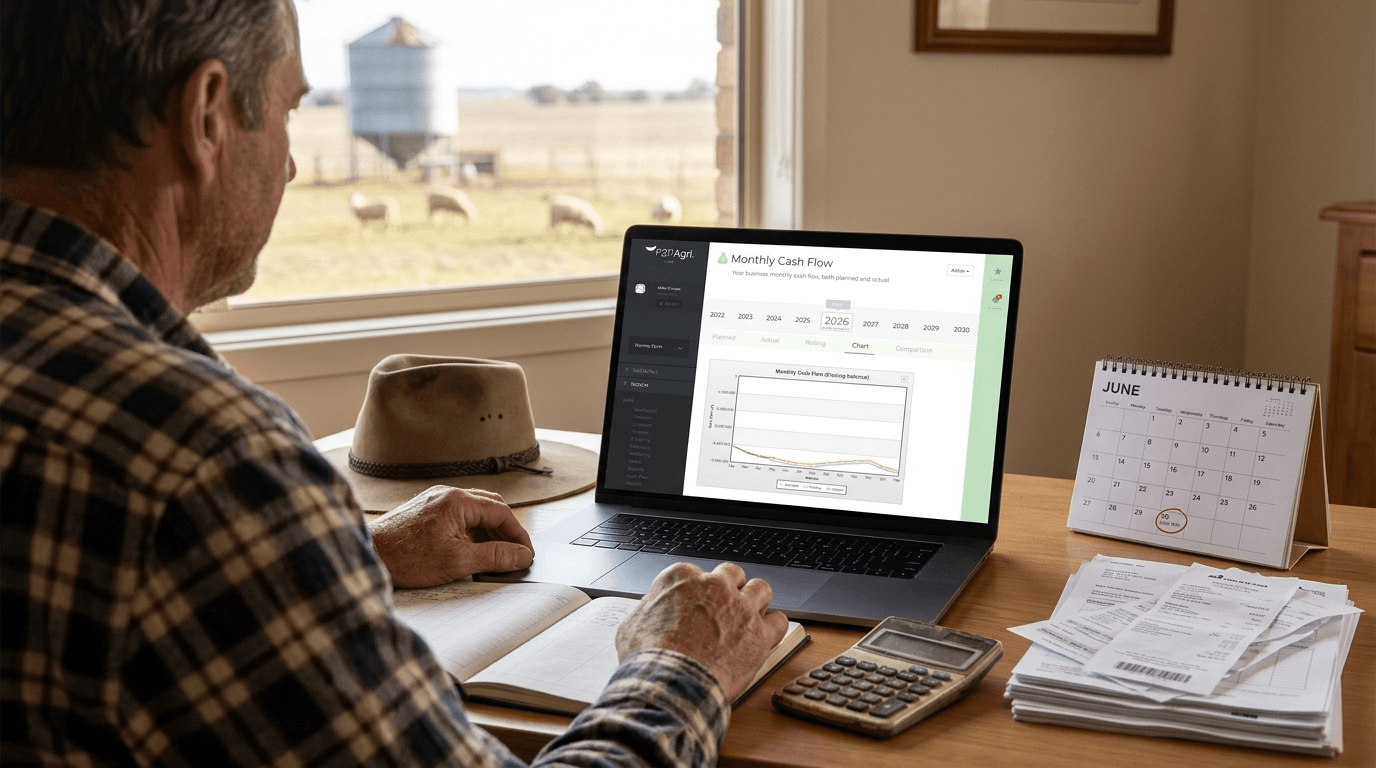
This is the same discipline behind a good farm business plan and a live cash flow budget. If you already track your numbers through the year, you walk into the EOFY conversation with your accountant knowing roughly where you will land. If you do not, the end of June is the moment it costs you.
Farm Management Deposits: The Biggest Lever in a Good Year
The Farm Management Deposit (FMD) scheme is the most powerful income-smoothing tool available to Australian farmers, and it exists precisely because farm income is so uneven. You make a deposit in a good year and claim it as a deduction, then withdraw it in a leaner year when it is taxed at a lower marginal rate. There was around $5.9 billion sitting in the scheme nationally at the start of 2026.
The headline rules are straightforward. A primary producer can hold up to $800,000 in FMDs. A deposit is deductible in the year you make it, as long as your non-primary-production income is under $100,000 that year. The deposit has to be lodged with an approved FMD provider (most rural banks offer them) on or before 30 June to count for 2025-26.
The part that matters in 2026 is the drought provision. Normally a deposit has to stay put for 12 months to keep its tax benefit, but if you are hit by severe drought or a declared natural disaster you can withdraw early without losing the deduction. With El Niño now declared for the 2026 season, an FMD built up in a strong year is exactly the buffer you want heading into a dry one.
The $20,000 Instant Asset Write-Off (and the Install-By-30-June Trap)
For 2025-26 the instant asset write-off lets a business with an aggregated turnover under $10 million immediately deduct the full cost of eligible assets costing less than $20,000 each. The $20,000 limit applies per asset, so you can write off several items, and anything at $20,000 or more goes into the small business depreciation pool (15 percent in the first year, 30 percent after that).
The trap is the timing. The asset has to be first used or installed ready for use between 1 July 2025 and 30 June 2026. Ordering a piece of equipment on 25 June and taking delivery on 3 July does not qualify for 2025-26. Paying a deposit is not enough either. It has to be on the ground and ready to work by 30 June.
One piece of context worth knowing before you rush: in May 2026 the Government announced it intends to make the $20,000 write-off a permanent feature from 1 July 2026, though at the time of writing that is an announcement, not yet law. The point is not to buy a header you do not need for a 30 cent deduction. It is to make sure any genuine, already planned purchase is timed and installed so the deduction lands in the year that suits your tax position.
Deductions That Are Unique to Primary Producers
Beyond the general write-off, farmers have their own set of accelerated capital deductions that most businesses do not:
Fencing. The cost of new fencing, or repairs of a capital nature to fencing, is immediately deductible in the year it is installed, with no dollar cap. Boundary or internal fencing finished before 30 June can be a sizeable deduction.
Fodder storage. Silos, hay sheds, grain storage and liquid feed tanks (any asset primarily for storing fodder) are also immediately deductible. Heading into a dry season, this is one deduction that doubles as drought preparation.
Water facilities. Tanks, bores, troughs, dams and the pipes that connect them are deductible over three years (one third each year). Useful, but not immediate, so factor the timing in.
The same install-by-30-June logic applies to all of these. If you prepay for fencing materials or a tank but the work is not done and the asset is not functional by 30 June, the deduction waits until next year.
Prepaying Expenses Under the 12-Month Rule
Small business entities can bring forward a deduction by prepaying certain expenses before 30 June, provided the service period is 12 months or less and ends in the following income year. Common examples are prepaying up to 12 months of interest on a loan, insurance premiums, rent or lease payments, and some inputs and services for the coming season.
Used well, this is a clean way to bring a genuine, planned cost into the current year when your income is high. Used badly, it is just spending cash early to defer tax by a year. As with everything here, the test is whether it is a cost you were going to incur anyway, and whether the timing suits your position across both years.
Primary Production Income Averaging
Income averaging is a quieter concession, and it works in the background. It compares your taxable income with your average over the current and previous four years. In a year where your income jumps above that average, you receive an averaging tax offset that softens the effect of moving into higher marginal rates on a one-off lump. In a year well below your average, the mechanism can run the other way.
You do not apply for it and you do not calculate it; the offset is worked out automatically and shown on your notice of assessment. It is worth understanding because it changes the maths on the other levers. Averaging already smooths some of the pain of a bumper year, so it is one more reason to model the full picture rather than reaching straight for an FMD or a big purchase.
Superannuation: A Deduction That Builds Wealth
For many farming families, super is the most under-used lever of the lot. A personal concessional (before-tax) contribution is deductible, and the concessional contributions cap for 2025-26 is $30,000 (this includes any employer or super guarantee contributions). If your total super balance was under $500,000 at 30 June last year, you may also be able to carry forward unused cap from up to five earlier years and contribute more.
Unlike most of the other levers, this one does not just defer tax, it moves money into a lower-taxed environment for your retirement. The timing rule is strict though: the contribution has to be received by your super fund before 30 June, not merely paid, so leaving it to the last day is risky. Super decisions also carry their own rules and trade-offs, so this is one to walk through with a licensed adviser.
Worked Example: Stacking the Levers After a Strong Year
Consider an individual primary producer who has had a strong 2025-26 and is looking at a taxable income of around $360,000 before any planning, well into the top marginal bracket. Working with their accountant before 30 June, they might combine several of the levers above. The numbers below are illustrative only.
Illustrative EOFY plan: individual primary producer, strong 2025-26
| Lever | Action before 30 June | Reduction in 2025-26 taxable income |
|---|---|---|
| Farm Management Deposit | Deposit $150,000 with an FMD provider | $150,000 |
| Instant asset write-off | Install an $18,000 grain silo, ready for use | $18,000 |
| Fencing (immediate) | Complete $22,000 of boundary fencing | $22,000 |
| Prepay expenses (12-month rule) | Prepay 12 months interest and insurance | $40,000 |
| Concessional super | Personal deductible contribution within the cap | $20,000 |
| Total | $250,000 |
Illustrative only. Taxable income falls from roughly $360,000 to $110,000 in this example. The FMD and the prepayments are smoothing (income and expenses shift into later years), while the write-off, fencing and super reflect genuine spending or saving. Your structure, turnover, marginal rates, the FMD non-primary-production income test and the $10 million write-off turnover test all need checking with your accountant before you act.
The important idea is not the size of the deduction, it is the smoothing. The $150,000 FMD is not gone; it is parked, ready to be drawn down and taxed in a leaner year, very possibly a dry El Niño year, when it lands in a lower bracket. That is the difference between using the tax system and letting it use you.
Your Pre-30-June Checklist
A practical order of operations for the next few weeks:
1. Estimate your taxable income for 2025-26 before you spend a dollar, so every decision is made against a real number.
2. Talk to your accountant early, not on 29 June. The good ones are flat out in late June, and several of these levers need a few days to execute.
3. Decide on FMDs and super, the two biggest levers, and make sure deposits and contributions are received before 30 June.
4. Check that any planned assets are installed and ready, not just ordered, by 30 June.
5. Confirm prepayments are genuine, planned costs and that the timing suits both years.
What This Looks Like in Practice
Every lever here turns on one thing: knowing your numbers before the year ends. The farmers who get the most out of EOFY are not the ones who spend the most in late June. They are the ones who can see their likely taxable income, their cash position, and the effect of each decision before they make it.
This is exactly what P2PAgri is built for. You can use scenario analysis to model the tax-planning options side by side and see the cash flow impact across the next few years, and connect your Xero or accounting data so the starting numbers are real rather than guessed. The software does not replace your accountant; it means you arrive at that conversation with the picture already in front of you.
For the underlying frameworks, the Farming the Business manual developed for the GRDC covers cost management and business performance in detail, and the guide to reading your tax return shows how to turn the same figures into management information. If you would rather work through it with a professional, find an accredited P2PAgri adviser in your region.
Frequently Asked Questions
When is the 2026 EOFY deadline for farm tax planning?
The Australian financial year ends on 30 June 2026. Most of the useful levers (Farm Management Deposits, asset purchases that are installed and ready for use, prepaid expenses, and super contributions received by your fund) have to be actioned on or before 30 June to count for the 2025-26 year. Once the date passes, the highest value decisions are behind you.
How much can I deposit in a Farm Management Deposit?
A primary producer can hold up to $800,000 in Farm Management Deposits. A deposit is deductible in the year you make it, provided your non-primary-production income is under $100,000 for that year. The money is taxed as income in the year you withdraw it, so the aim is to deposit in a strong year and draw it down in a leaner one.
What is the instant asset write-off threshold for 2025-26?
For 2025-26 the instant asset write-off is $20,000 per asset for businesses with an aggregated turnover under $10 million. The asset must be first used or installed ready for use between 1 July 2025 and 30 June 2026. Ordering or paying for it is not enough on its own; it has to be installed and ready by 30 June. Assets costing $20,000 or more go into the small business depreciation pool instead.
Can primary producers immediately deduct fencing and fodder storage?
Yes. Primary producers can claim an immediate deduction for capital spending on fencing and on fodder storage assets such as silos and hay sheds. Water facilities such as tanks, bores, troughs and pipes are deductible over three years. In every case the asset has to be installed and functional by 30 June, not simply paid for.
What is primary production income averaging?
Income averaging evens out the tax effect of a lumpy income by comparing your taxable income with your average over the current and previous four years. In a year where your income is above that average you receive an averaging tax offset, which softens the hit of a bumper year. It is worked out automatically on your notice of assessment.
Should I spend money just to save tax before 30 June?
No. A deduction only ever returns your marginal tax rate, somewhere between 30 and 47 cents in the dollar, so spending a dollar you do not need still leaves you out of pocket. Good end-of-financial-year planning is about smoothing income across years and bringing forward genuine, already-planned spending, not buying things for the deduction. Always confirm the detail with your registered tax agent.
Where to Go From Here
The end of the financial year rewards preparation, not panic. Estimate your position, understand which of these levers fit your year, and get the timing right before 30 June. Do that, and a strong season turns into lasting financial strength rather than a one-off tax bill. Leave it to the last week, and the system makes the decisions for you.
The figures in this article are current as at June 2026 and are general information only. Tax thresholds and rules change, and your circumstances are your own, so use this as a checklist for the conversation with your registered tax agent or accountant, not as a substitute for it.
Keep reading
What Supplier Trade Credit Actually Costs You (Compared With an Overdraft)
What does supplier trade credit really cost compared with an overdraft? Work out the true rate on settlement discounts and price premiums for farm inputs.

Farm Lending After the Royal Commission with Matt O'Dea
Podcast: ex-agribusiness banker and broker Matt O'Dea on farm lending after the Royal Commission, hidden fees, brokers and choosing a bank that sticks.

What Banks Really Look For When Lending to Farmers
Podcast: what banks really look for when lending to farmers. Mike Krause explains the three things every lender weighs up and how you can influence your rate.