
What Is P2PAgri? Modelling Your Farm's Future with Mike Krause
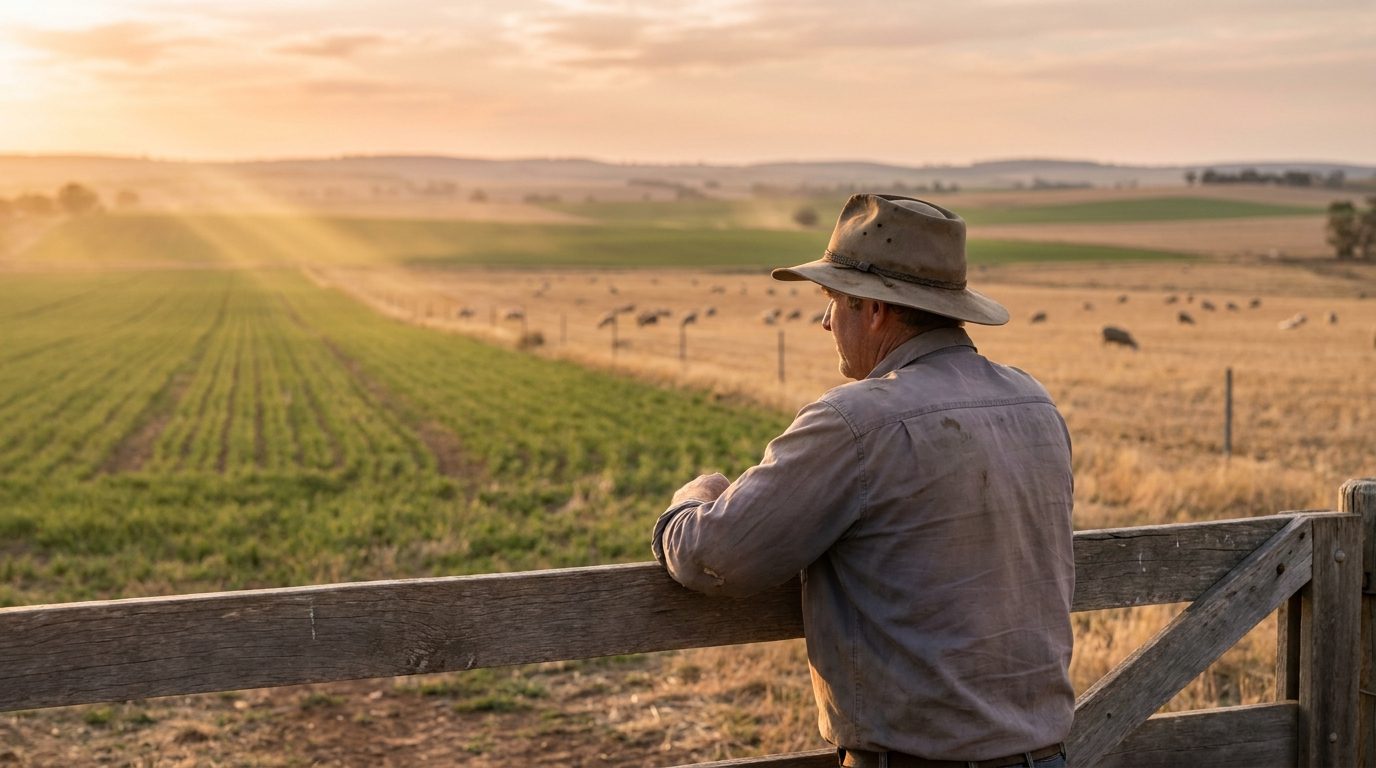
Podcast transcript from Your Farm Business Podcast
What exactly is P2PAgri, and what can farm business modelling actually tell you about your future? In this episode of Your Farm Business Podcast, host Tom Moir sits down again with Mike Krause, founder and CEO of P2PAgri, to dig into the platform itself: where the name comes from, why it was built, and how farmers across Australia are using it to answer the big questions, like whether to buy the neighbour's place and what happens if drought follows.
Along the way, Mike explains the three levers every farm business should watch (liquidity, efficiency and wealth), why your bank, accountant and adviser all see your business differently, and how P2PAgri's free Essentials tool lets you see your farm through your banker's eyes before you ever sit down at the bank.
What Does P2PAgri Stand For?
Tom Moir:
This is Your Farm Business Podcast, brought to you by P2PAgri. My name is Tom Moir and I'm your host for this episode. Today we're chatting with Mike Krause, the founder and CEO of P2PAgri. G'day, Mike.
Mike Krause:
G'day, Tom. How are you going?
Tom Moir:
I'm very well, mate. It's good to be back for another episode to find out the history of P2PAgri, what it is and what it entails. So to kick things off, Mike, let's start right at the beginning. What is P2PAgri? What do the letters stand for?
Mike Krause:
P2PAgri stands for Plan to Profit Agri, Tom. We were set up to help empower farmers to understand what drives their profitability, and to use computer technology to help with decision making. As simple as, do I put nitrogen on this season? Or the neighbour's come up for sale, and what happens if I buy the property and we have a couple of years of drought? Will the bank still love me? Will that work? So it's really about helping farmers manage the small and the big risks of their business a lot more easily.
Where the Idea Came From
Tom Moir:
And so what was the development journey behind P2PAgri? How did you come up with the idea in the first place?
Mike Krause:
Probably a combination of a number of things, Tom. Back in the early part of my career, and this will tell you how old I am, computers were going from big buildings to suddenly sitting on desktops. I quite enjoyed statistics at uni, as well as farm business management, and I thought, that's my future. So I went off and did some study in New Zealand into using computer modelling to do simulation for farm businesses. When I came back to Australia, spreadsheets hit the deck, and I thought, I don't have to program in Fortran anymore, I can do it all in spreadsheets.
We were happily doing that, but what I found was that every time I came to a new farm with different questions, I'd have to build different spreadsheets. That was fine, but it was very time consuming. I kept working away at it, thinking there's a future in this. I was also involved in running Risky Business, a farming game built in Excel where we'd run five seasons in a day, and farmers wouldn't give my computers back at the end of it. That highlighted to me that farmers really understood modelling and what-if analysis. They'd probably done it on the back of envelopes before, but now we could use computer technology to help them.
At the same time, I had an adviser look over my shoulder and say, I'm pretty impressed with your Excel spreadsheets, Mike. Can I have them for my farmers? And I said, I can't give the spreadsheets away, because they're a bit problematic when you type over a formula you're not expecting to, and suddenly the results aren't correct anymore. So I realised advisers would like to use this technology with their farmers too.
About the same time I had a benchmarking project in South Australia where we collected over 200 farmers' data. Benchmarks will give you an understanding of how well you're going against the population, but then farmers would come back to me and say, my neighbour's come up for sale, what are my benchmarking numbers telling me? Do I buy the neighbour? Now, if anyone's played with benchmarking numbers, sometimes they're about as useful as reading the tea leaves in your teacup. They can't necessarily answer those complex questions. It really comes back to understanding what drives our profits, what drives our balance sheet, and what drives our cash flow. That's really where P2PAgri came from: we wanted a balanced software program that farmers could use themselves, that would give them answers from those three perspectives, and help them answer that question when the neighbour comes up for sale. Should we do it or not?
Tom Moir:
Okay, so it was more than just giving advice. There are a lot of advisers and a lot of people you can sit down with to get data together to make decisions, but it sounds like you were bringing all of that into one place, going beyond advice to actually running specific models.
Mike Krause:
Yeah, exactly. And relative to that particular farm, Tom. The challenge was to develop a software program where Tom the farmer could tailor the software to reflect his particular business, whether he's a grain grower in a low rainfall area, a grazier in a high rainfall area, a grape grower in the Barossa Valley, or a cotton grower at Moree. And I always had a passion to teach farmers how to do this themselves. I'd rather teach you how to fish, Tom, than give you a fish.
So we got involved in developing software that was logical and simple enough for farmers to learn to use themselves. Not necessarily to say they have to use it, but to educate themselves so the questions they're asking their advisers, their accountants or their bankers are at a higher level, and they get better value from those experts, rather than handing all the decision making for the farm over to them. Some farmers have told me, the bank said they'd lend me money for that land, so it must be a good thing to do. No, not necessarily. I want farmers to understand that, and to build their skills and knowledge as business people.
Tom Moir:
And how does that work practically, Mike? It sounds quite detailed and specific to your circumstances. I imagine you'd have to do a fair bit of training with a farmer to get them to understand how the software works. Is that a component of the service on offer?
Mike Krause:
Look, it is, Tom. Some farmers have been through Marcus Oldham or Curtin Uni or other universities where they may have done farm business management training, and they manage to pick up our software and run with it. The software has a lot of on-board training video clips, and recently we put up an AI bot, so we've trained AI to answer questions users might have on the platform. Other people may not have that background but want training to improve their financial literacy. So we have a proven training program where farmers grab our software and we train them through a combination of group Zooms and one-on-one Zooms where confidentiality is maintained, plus another series of quite extensive training videos they can work through in their own time, in their own office, to get their data up to speed.
Riding the Technology Wave, From GST to AI
Tom Moir:
Something you would have come across in the agricultural space is a bit of pushback against technology being integrated into farm business and planning. And you mentioned AI, the dirty word, which is another brand new thing on the spectrum. Over your many years of experience, how have you seen technology integrate, and how important is it?
Mike Krause:
Look, I think it's vitally important, Tom. Listeners will remember when GST was thrust upon us in 2000. Suddenly farmers had to go from collecting receipts in a shoebox and carting them off to the accountant, to recording everything in a regular fashion so they could put their monthly or quarterly BAS in. Farmers adopted technology quite quickly then. And technology continues to change in agriculture. It wasn't that long ago our grandparents were using horses. No one uses horses anymore, they're using tractors, and now some of those tractors are becoming remote controlled. We're changing continually.
My view on technology is don't be too scared of it. Early adopters may make mistakes, so it's sometimes good to hang back a bit and learn from them before you take on that technology yourself. But I saw new technology coming through in our own business. When we started, it was desktop software written in Visual Basic that lived on your hard drive. Then cloud technology came about, and that's allowed us to do much more effective data collection and analysis. In our case, you could be using Xero as your accounting package, collecting all your income and expenditure in that. Xero doesn't really help a lot with forward planning, which is what our software does, but we can pull the relevant data in from Xero so you're not re-entering it, and then use our software for management decision making.
Now AI has arrived. I must admit, twelve months ago I thought AI was going to ruin our business. But the more I thought about it, AI is like a huge wave building up off the coast. We can stand still and be swamped by it, or we can get on our surfboard, paddle hard, and ride that wave. We're using AI in about five different places in our business at the moment, and it's improved our productivity about fivefold. What the team was doing two years ago, they're doing five times more of now. And it's the same for farmers: look at the technologies that really help improve your productivity and profitability, and adopt those.
Banks, Accountants and Advisers: Whose Motivation Is Whose?
Tom Moir:
Going back to something you mentioned before, Mike: the relationship between farm advisers, accountants, banks, even your livestock agent. There are lots of people who come around the table to help you run your farm, and the roles sometimes get confused. You mentioned the bank being happy to give me the loan doesn't mean it's a good idea, because the bank's not the adviser, they're just the lender. So what's the difference between what the banks do, what the accountants do, and where your software fits in? What do farmers often miss in that triangle?
Mike Krause:
That's a really good in-depth question, Tom. I'd start by looking at the motivation of your banker, your adviser and your accountant. A lot of farmers assume their motivations line up with the farm business's motivation. Put yourself in your banker's shoes. The banker makes money by taking depositors' money and lending it out, with a margin in between. So they're concerned with: if I lend Tom some money, is he a viable business, and am I going to get my money back? Whether Tom's making a little bit of profit or a lot of profit doesn't really worry the bank. All they're worried about is that there's enough money there to pay the interest and the principal when needed. So the motivation of a banker is slightly different from you as a farmer looking to really improve your profitability.
The same with the accountant. Most accountants I'm aware of are motivated to help Tom minimise the amount of tax he's going to pay, which is a good thing. We don't want to pay more tax than we have to. But sometimes minimising tax in all our decision making takes away some of the strategic gains we could make in the business. If we're making more profits, let's make more profits and worry about the tax after, rather than worrying about the tax before we decide on our profit levels. And with advisers, some advisers' objective is the number of farmers they're servicing. If I can go from 20 farmers to 40 farmers, I'm going to increase my income. And sometimes the service from advisers gets restricted because they're so busy.
So the challenge we have as farm business owners is to be very clear on why we're farming and where we're going. When I put you on the sandhill in ten years' time and you look back at your farm, what would you like to have achieved? Once you've got that clear in your mind, those are the key questions that help your bankers, your agri business advisers and your accountants help you along that journey. But you're the person holding the rudder of your ship. You know what dot on the horizon you're heading for, and you're using their advice to help you get there.
The Three Levers: Liquidity, Efficiency and Wealth
Tom Moir:
In terms of your experience using the software with your own clients, how has it increased their confidence in what they're doing with their business? They may have traditionally had their advisers and their bank come in for discussions, and now they're working with the software and able to model future decisions with a fairly high degree of accuracy.
Mike Krause:
Look, it's given them a lot more confidence in knowing they can look at the future. A couple of things I want to mention there, Tom. In a previous interview I talked about a book called Farming the Business that GRDC got me to write. In there, we look at the three main levers of a business that we should be watching. One is liquidity, which is cash flow. It's important to know when the money's coming in, when it's going out, and the bank wants to know your overdraft out of that. The second is wealth: what's our balance sheet doing? Are we building our wealth over time? That's generally what the banks are keen to know, because if they lend to Tom and his wealth goes up, their lending is secure. But the one that's a bit forgotten is efficiency: how efficiently is Tom using the assets in his farm? Is he getting a good return compared to the rest of the industry?
In our training with farmers, we talk about those three levers, and that we should focus on all three, not just one. Our software helps farmers put those numbers in and helps with their decision making. The software gives a glimpse of the past, so we can see where Tom's farm has come from. Then we look at this year in detail from the paddock up: what paddocks Tom owns, leases or share farms, what crops or pastures are going in, and we build a picture of the cash flow, the expected efficiency of the farm, and the wealth. Once we've done that for this season, the program takes that data and replicates it for the next five years. And I'd say to Tom, you're not going to have an average year for the next five years. One's going to be a bad one, one's going to be a good one, a couple might be average. So let's model those seasonal variations into the next five-year plan. Once we've done that, we've got a set of five-year data we can do what-ifs with. What if we buy the neighbour out? We buy the neighbour out and it's a drought, how bad does it get? Are we still viable? Our software can answer all those questions.
Tom Moir:
That would be fantastic, seeing a couple of real-world examples of what it looks like.
Mike Krause:
Okay, I'll share a couple of examples here. This is our scenario analysis tool, where you can see a number of lines on a chart. This is a farm that's not doing that well. Its annual cash flow is negative, and we've modelled a drought in 2026. We're not saying it's going to be a drought this year, but we've modelled one, then gone back to average years, and we can see that from a cash perspective the farm might be questionable as to whether it's viable. They thought a good strategy would be buying more land, and that light grey line shows us that no, in every seasonal condition we've modelled over the next five years, we're going to be losing more money. So that may not be a good strategy. That's the cash view. This is the cumulative cash: if we follow that strategy, we'll have to depend on the bank lending us more money. Let's look at our efficiency, our profitability. The light grey line in most instances is poorer than if we didn't buy that land. It drops our equity down because we're borrowing more money. Does it make us more efficient? Only in the good seasons. What's it going to do to our net worth? We know land values have been increasing, but it might take four or five years for our net worth to improve from buying that land.
So what we try to do in the software is show what the likely results will be across liquidity, efficiency, and the balance sheet and wealth. Farmers find that really good for making those decisions. The other thing, in Essentials, is that we analyse your business like a banker would. We teach you how your bank looks at things. They like to look at a certain number of ratios, so we take your data, without manipulating it, and re-present it back to you so you can see how your farm is going compared to what the bank and the industry expect. If it's in the green, we're going well. If it's in the yellow, we're average. If it's in the red, it needs attention. We try to show the software with charts and dials so you can read the data a lot more easily, and we've put a lot of emphasis on making it logical, so it's relatively easy to learn and come back to.
Tom Moir:
Yeah, that's fantastic. A lot of people are starting to use AI to try to answer individual aspects of some of those questions, but that's only one small aspect of those three levers you mentioned. Seeing the screens there, it's all in one place. You can track the history, you can model the future, and you can change the data to see good and bad years. It must have taken quite a while to get that ironed out.
Mike Krause:
Look, we've only touched the surface of what AI might do with it. At the moment, none of the analytics in the software uses AI. It comes from many, many years of Excel spreadsheet development, knowing what ratios affect what. Our platform is a modelling platform rather than a database platform, which a lot of our competitors have, where they focus more on cash flow. Cash flow is really important, and we do it as well, but it's also important to model these other elements forward so you're in a better position to make decisions.
Tom, I might just touch on our training. Prior to COVID, I'd ask a farmer, can I see you on Zoom? No, not doing Zoom. Then COVID hit, and the adoption of technology like Zoom and Teams happened almost overnight. At that time we were training farmers with some government grants, and the government said, you can't train them the old way, going to the CWA hall once a week and getting the farmers around the table. You've got to do it all on Zoom. We started doing that about four or five years ago, and we're now running a really effective training program through Tocal Ag College in the Hunter Valley in New South Wales, where we train up to a hundred farmers a year using our software. The beauty is the farmers use their own data to improve their knowledge. They don't have to use our software after the course, but we've done it with a rhythm of group training and one-on-one Zoom training, and we've perfected it to the point that farmers tell us they don't want to go back to the old way of doing it.
They're learning from their own data, they're learning where their business can go in the future, and it's quite enlightening for them, both improving their financial literacy and using the software to see what's really driving their business. People are making decisions like, do I keep going with my Merino stud? Wool prices are not good at the moment, and we've got a history of genetics here, but we can see that our cropping program or our haymaking program is driving the business more. So it's helping them make some really significant decisions going forward.
Who Is P2PAgri For?
Tom Moir:
So who is P2PAgri for, Mike? Does it depend on whether you've got so many acres or you're running so many sheep? Who benefits most from using the software?
Mike Krause:
Look, Tom, it's really for those who are inquisitive and want to know how to further improve the financial performance of their business. Whether you're large or small, the principles are effectively the same, so there's no cut-off. We service every industry in agriculture with a couple of exceptions: we don't service dairy, and we don't service eggs that well. But if you're a vigneron, a citrus grower, a vegetable grower, a cotton grower, a cropper, livestock or mixed farming, we can help the full range. We have farming clients using us all over Australia. So it's not your size, it's your desire for your business. If your desire is to further improve it, this is a skill that we know is really effective in helping direct and improve your business over time.
Tom Moir:
And if someone is on the other side of Australia from you in South Australia, Mike, they can do the software training and the one-on-ones they need on Zoom, remotely, and learn everything they need to know?
Mike Krause:
Exactly. And it's not just dependent on me, Tom, we've got a team of people I can put them on to. We do formal training, or we can do bespoke training specific to the people and the skill base they come to us with. If they're at a higher level, we can help them move higher again. If they're at a lower level, that's fine, we'll start there and keep building their knowledge up.
How to Get Started with P2PAgri
Tom Moir:
So what's the best way for people to find out more, Mike? Is it better to jump on the website, or to contact you for a chat?
Mike Krause:
Good question, Tom. Whatever people feel comfortable with, but I'd head to our website, just Google P2PAgri. You can have a look at a demo there, which is free, and you can sign up for free. Our Essentials, which is the one I just showed you with the dials, is actually free software, and we'll help train you to understand how your business has been going through the eyes of your bank. Your bank likes to look at these sorts of numbers, so if you're talking to your bank, you're pre-educated as to what the bank is looking for, and they'll say, I'm pretty impressed, Tom knows his financial stuff, we might put him in the better basket for lending. So come to us for that, and we can lead you through the free part. It gives you an experience of our training and our software. If you're using Xero, it brings the data in from Xero so you don't have to do a lot of data entry. That's a good way to start, and then you can decide how you want to move on from there, just using the software, or using the software with our training and support to get you really up to speed.
Tom Moir:
Fantastic, Mike. I think we'll leave it there for this episode, but that was a beautiful overview of P2PAgri, the services on offer and how you conduct it as well. There are obviously many, many benefits to being able to model, with very accurate data, how your business operates and how you can plan to make it more profitable. So thank you very much for your time today.
Mike Krause:
No worries. Thanks, Tom. Appreciate it.