
Water Use Efficiency Calculator for Grain Growers (WUE)
Water Use Efficiency (WUE) has long been a cornerstone measure for grain growers, particularly in dryland farming systems across southern Australia. In an environment where rainfall is often the most limiting and variable factor, understanding how effectively that rainfall is converted into crop production is critical. WUE provides a simple yet powerful way for farmers to assess performance, refine management practices, and ultimately improve productivity over time.
The Origins of Water Use Efficiency
The concept of Water Use Efficiency dates back to the early 1980s, when two scientists—Reg French and Jeff Schultz—set out to better understand what constrained grain yields in dryland systems. Their research led to a pivotal insight: in many cases, the primary limiting factor for crop production was not soil type, fertiliser, or machinery, but simply the amount of water available to the crop.
In southern Australia, this water largely comes from growing season rainfall, typically falling between April and October. While summer rainfall in January, February, and March can contribute to stored soil moisture, it is the in-season rainfall that plays the dominant role in determining crop outcomes.
However, not all rainfall is converted into plant growth. Some is lost through evaporation, runoff, or inefficiencies within the farming system. This is where WUE becomes particularly valuable.
How WUE Is Measured
Water Use Efficiency is commonly expressed as kilograms of grain produced per millimetre of growing season rainfall (kg/mm). It can also be benchmarked as a percentage of an estimated “potential” yield based on available water. In simple terms, WUE answers the question: “Given the rainfall received, how well did the crop perform?”
The strength of WUE lies in its ability to normalise performance across different seasons. In dry years, average years, and wet years alike, farmers can use WUE to assess how effectively they utilised available moisture. This makes it a far more meaningful metric than yield alone, which can be heavily influenced by seasonal conditions outside a farmer's control.
The model developed by French and Schultz accounts for several important factors:
- It recognises that crops require a baseline amount of water before they begin producing grain.
- It adjusts for evaporation losses that vary depending on crop type and seasonal conditions.
By incorporating these elements, the model provides a realistic benchmark for what is achievable under a given rainfall scenario.
Management Strategies That Influence WUE
One of the most important implications of WUE is that it shifts the focus from uncontrollable factors—like rainfall—to controllable management decisions. If rainfall is the primary limiting factor, then the role of the farmer is to ensure that every millimetre of water is used as efficiently as possible. This opens the door to a wide range of management strategies that can influence WUE:
- Sowing timing: Sowing at the optimal time ensures that crops establish well and make the most of early-season moisture.
- Fertiliser application: Appropriate fertiliser application supports strong crop growth, enabling plants to convert water into biomass and grain more effectively.
- Weed control: Weeds compete directly with crops for water, nutrients, and light. Effective weed management ensures that available moisture is used by the crop rather than lost to unwanted plants.
- Disease control: Controlling diseases helps maintain crop health, allowing plants to fully utilise the water they receive.
- Tillage management: This could be soil type specific and range to no-tillage.
- Harvest timing and crop management: Each decision, from paddock preparation through to harvest, contributes to how efficiently water is used within the system.
The Shift in Mindset
A key insight from the early adoption of WUE was the realisation among farmers that they were often operating well below their potential. Many growers in the 1980s were satisfied with their yields, believing they were achieving reasonable results given the conditions. However, when WUE analysis revealed that some were only reaching around 50% of their potential efficiency, it created a powerful shift in mindset.
Rather than accepting yield as a fixed outcome, farmers began to see it as something that could be improved through better management. This led to widespread adoption of improved farming practices, including better timing of operations, reducing soil disturbance, more strategic use of inputs, and a greater focus on agronomy. As a result, grain production across many regions increased significantly during that period.
WUE as a Tool for Continuous Improvement
What makes WUE particularly valuable is its ability to provide a consistent and objective measure of performance. Because it accounts for seasonal variability, it allows farmers to compare results from year to year in a meaningful way. A low-yielding year may still represent a strong performance if rainfall was limited and WUE was high. Conversely, a high-yielding year may reveal inefficiencies if rainfall was abundant but not fully utilised.
For modern farming businesses, this makes WUE an essential tool for continuous improvement. By reviewing WUE annually, farmers can identify trends, benchmark their performance, and pinpoint areas where management can be refined. Over time, this leads to more informed decision-making and better use of available resources.
Importantly, WUE also encourages a proactive approach to farm management. Instead of reacting to seasonal conditions, farmers can plan and implement strategies aimed at maximising efficiency regardless of the year. This mindset is particularly valuable in the face of increasing climate variability, where making the most of available rainfall is more important than ever.
Reviewing WUE Each Season
In practical terms, reviewing Water Use Efficiency each season provides valuable insights. It helps answer key questions such as:
- Did the crop perform as expected given the rainfall?
- Were there missed opportunities to improve efficiency?
- What management changes could be made to achieve better results next year?
By consistently asking these questions, farmers can build a deeper understanding of their systems and make incremental improvements over time. The goal is not necessarily to achieve 100% efficiency every year, as this may not always be possible. However, to continually move closer to that benchmark is a good goal.
More Than Just a Metric
Ultimately, Water Use Efficiency is more than just a metric; it is a way of thinking. It reframes the challenge of farming in dryland environments, focusing attention on what can be controlled and improved. By measuring and managing WUE, farmers can ensure they are making the most of every drop of rainfall, driving both productivity and profitability in a sustainable way.
As agriculture continues to evolve, the principles behind WUE remain as relevant today as they were when first introduced. For grain growers in southern Australia and beyond, it remains one of the most practical and insightful tools for understanding performance and guiding better farm management decisions into the future.
WUE in P2PAgri
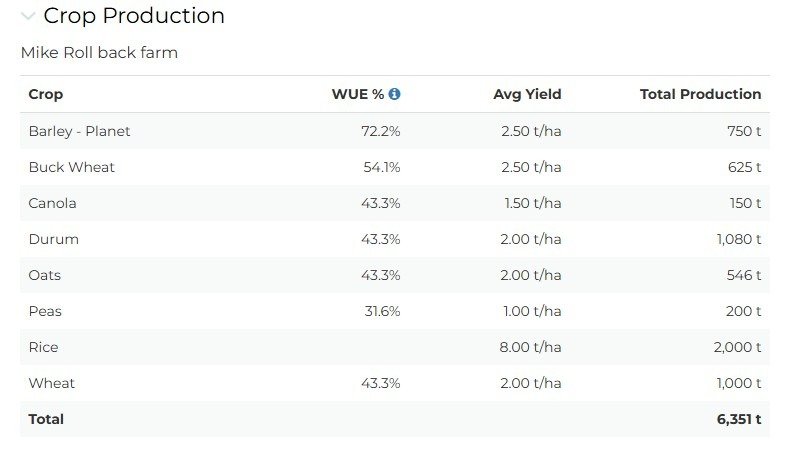
P2PAgri will calculate the WUE for your dryland crops once the paddock yields are entered in SEASON > Cropping > Yield and the rainfall records for that growing season are recorded in SEASON > Rainfall.